

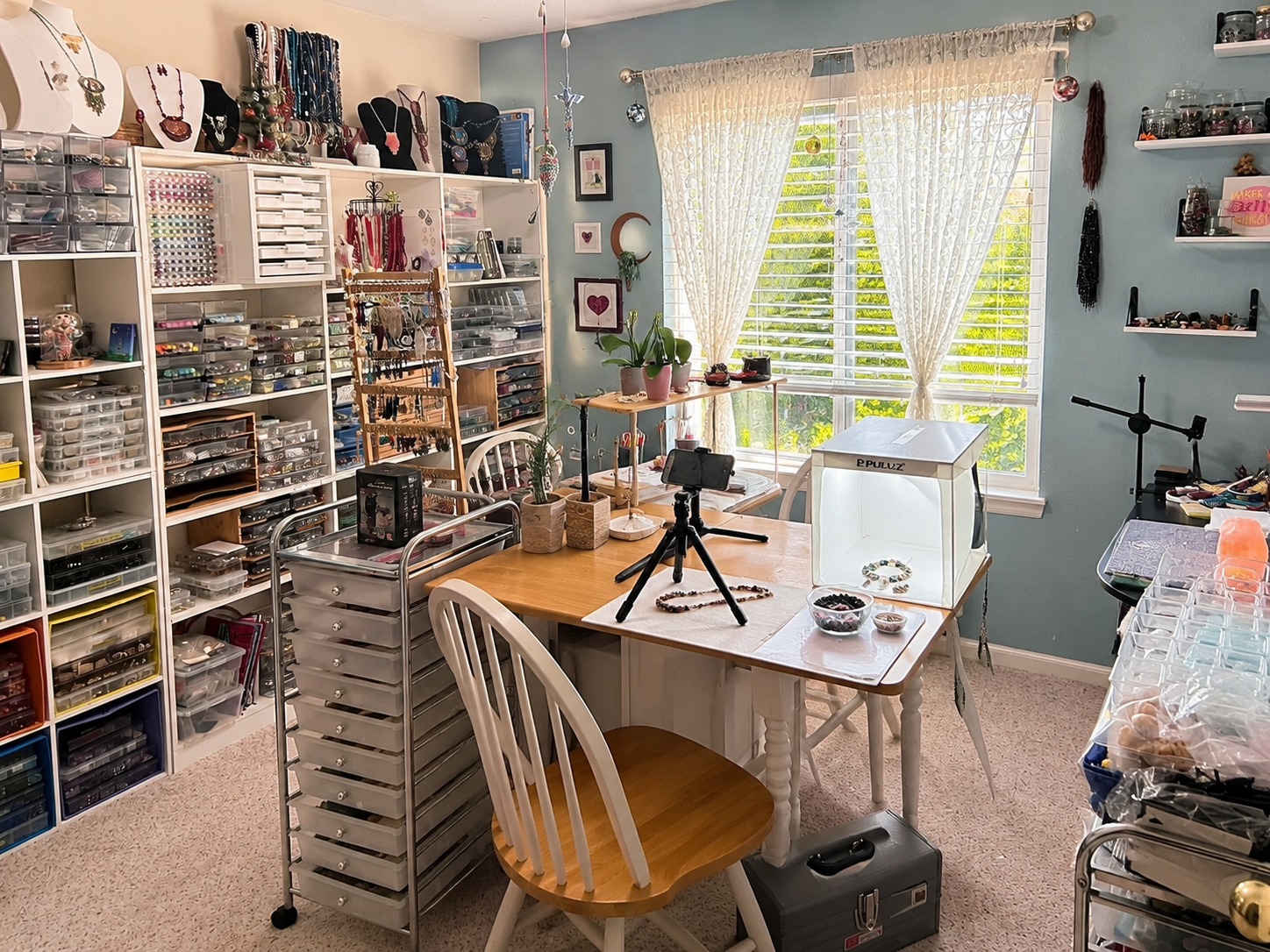
Turning Your SmartPhone Into a Jewelry Camera
Beautiful jewelry photography doesn’t require expensive equipment. Discover how natural light, patience, and a few simple tools helped us turn a smartphone into one of the most valuable tools in our studio.
Finding Beauty in Light, Detail, and the Handmade Process
This article contains affiliate links. As an Amazon Associate, Sun & Thread Sisters earns from qualifying purchases at no additional cost to you. We only recommend products we personally use, love, or believe would genuinely help fellow makers and artists.
When we first began photographing jewelry for Sun & Thread Sisters, we assumed beautiful product photography required expensive cameras, professional studios, and complicated lighting equipment.
What we discovered instead was something surprisingly encouraging:
Thoughtful light matters more than expensive gear.
Many of our favorite photographs have been created with nothing more than a smartphone, a nearby window, and a few simple tools that help capture the sparkle, texture, and tiny details that make handmade beadwork so special.
Jewelry photography presents unique challenges. Metallic finishes reflect everything around them. Crystals catch light in unexpected ways. Tiny seed beads that look vibrant in person can suddenly appear flat or dull in a photograph.
Learning to photograph handmade jewelry has become its own creative skill — one that continues to evolve alongside our beadwork.
Today we'd like to share a few of the lessons we've learned while turning an everyday smartphone into one of the most valuable tools in our studio.
Find the Light Before You Find the Camera
The single biggest improvement we ever made to our jewelry photography had nothing to do with the camera itself.
It was the light.
Natural window light remains our favorite way to photograph beadwork because it reveals texture and color in a way that artificial lighting often struggles to reproduce.
A north-facing window provides soft, consistent light throughout much of the day, while east-facing windows often create beautiful morning illumination. Harsh midday sunlight can create bright reflections and strong shadows, so we usually prefer indirect light whenever possible.
Sometimes moving a piece just a few inches closer to the window can completely transform the photograph.
When photographing metallic finishes, crystals, or iridescent seed beads, patience often becomes more important than equipment. Rotating the jewelry slightly or waiting for the light to soften can reveal details that were invisible only moments before.
Light is not simply part of the photograph.
In many ways, light becomes part of the design itself.
Stability Creates Sharpness
Seed beads are small.
Very small.
The incredible detail that makes beadwork so beautiful also makes it surprisingly difficult to photograph. Even the slightest movement of the camera can soften edges, blur bead holes, or reduce the sparkle of crystals and metallic finishes.
For a long time, we simply held our phones and hoped for the best.
Eventually we discovered that stability creates clarity.
Whether using a tabletop tripod, resting the phone on a stable surface, or using a simple phone stand, reducing camera movement creates noticeably sharper images and allows the tiny details of handmade work to shine.
This becomes especially important when photographing:
Size 15/0 seed beads
Crystal accents
Delicate fringe
Metal findings and clasps
Textured bead surfaces
Sometimes the smallest improvements create the biggest differences.
One of the simplest improvements we made to our photography process was reducing camera movement. A stable phone allows tiny details like seed beads, crystals, and metal finishes to remain sharp and clear.
We especially appreciate a tripod that can function as both a tabletop stand and a portable photography tool for studio work, tutorials, and artisan events.
View our recommended tabletop phone tripod
The Magic Lives in the Details
One of the greatest joys of beadwork is found in the details.
The soft glow of matte finishes.
The sparkle of faceted crystals.
The subtle color shifts of metallic seed beads.
The way thread disappears into the structure of a design while quietly holding everything together.
These details are often what make someone stop scrolling and take a second look.
Close-up photography allows those details to tell the story of the piece.
A single image of a clasp, bead texture, or crystal reflection can sometimes communicate more craftsmanship than an image of the entire necklace or bracelet.
As artists, we spend countless hours making these details matter.
Photography gives them the opportunity to be seen.
Capturing those details can sometimes be difficult with a smartphone camera alone. A clip-on macro lens allows you to photograph bead textures, crystal sparkle, metallic finishes, and intricate thread paths with much greater clarity and detail.
We especially appreciate versatile lens kits that allow both close-up macro photography and wider shots for larger pieces such as necklaces and amulets.
View our recommended macro lens kit for smartphones
Editing Should Reveal, Not Redesign
This philosophy has become one of the guiding principles of photography at Sun & Thread Sisters.
Our goal is never to create a prettier version of the jewelry than what arrives in the mailbox.
Instead, our goal is to create photographs that represent the piece as honestly and beautifully as possible.
We may adjust exposure, brightness, white balance, contrast, and sharpness.
But we never alter bead placement, colors, gemstones, crystal finishes, thread paths, hardware, or handmade construction.
Every piece carries the fingerprints of the creative process.
Those details deserve to remain exactly as they were created.
Authenticity matters.
The jewelry in the photograph should always be the jewelry that arrives in your hands.
Creating a Studio That Works for You
One of the most encouraging discoveries in our photography journey has been learning that a professional studio isn't required to create beautiful images.
Some of our favorite tools are surprisingly simple:
A nearby window
White poster board for reflecting light
Neutral backgrounds
A steady surface for the camera
A little patience
A willingness to experiment
Every artist eventually develops their own photography style just as they develop their own artistic voice.
Some prefer dramatic shadows.
Some prefer bright, airy images.
Some photograph outdoors while others create miniature studios inside their homes.
There is no single correct approach.
The best setup is often the one that encourages you to continue creating.
Natural window light remains our favorite photography tool, but cloudy days, winter evenings, and late-night creative sessions do not always cooperate.
A portable light box can provide soft, even lighting and consistent backgrounds, making it easier to photograph jewelry regardless of the season or time of day.
View our recommended photography light box
The Camera You Already Own May Be Enough
One of the most valuable lessons we've learned is that beautiful photography rarely begins with expensive equipment.
It begins with observation.
It begins with learning how light moves across a piece of jewelry.
It begins with noticing how crystals catch the morning sun or how metallic seed beads shift colors throughout the day.
Most of all, it begins with practice.
Photography, much like beadwork itself, improves one project at a time.
If you're a fellow artist, maker, or creative business owner, we hope these ideas encourage you to experiment, play, and share your work with confidence.
The world deserves to see what you're creating.
Sometimes all it takes is the camera already sitting in your pocket.
Final Thoughts
The best camera is rarely the most expensive one.
More often, it's the one that's already nearby when inspiration strikes.
At Sun & Thread Sisters, we've learned that photography and beadwork share something important in common: both reward patience, both improve with practice, and both invite us to slow down long enough to notice the details that make something truly special.
If you're a fellow maker, artist, or small business owner, we hope these ideas encourage you to pick up the camera you already own and begin sharing your creative journey with confidence.
Sometimes all it takes is a little light, a little curiosity, and the camera already sitting in your pocket.
Until our threads cross again...
May your thread stay untangled, your needle easy to find, and your creativity always lead you somewhere unexpected.
With gratitude,
Kristina & Kimberly
Sun & Thread Sisters
Nature Inspired • Heart Made • Sister Crafted.
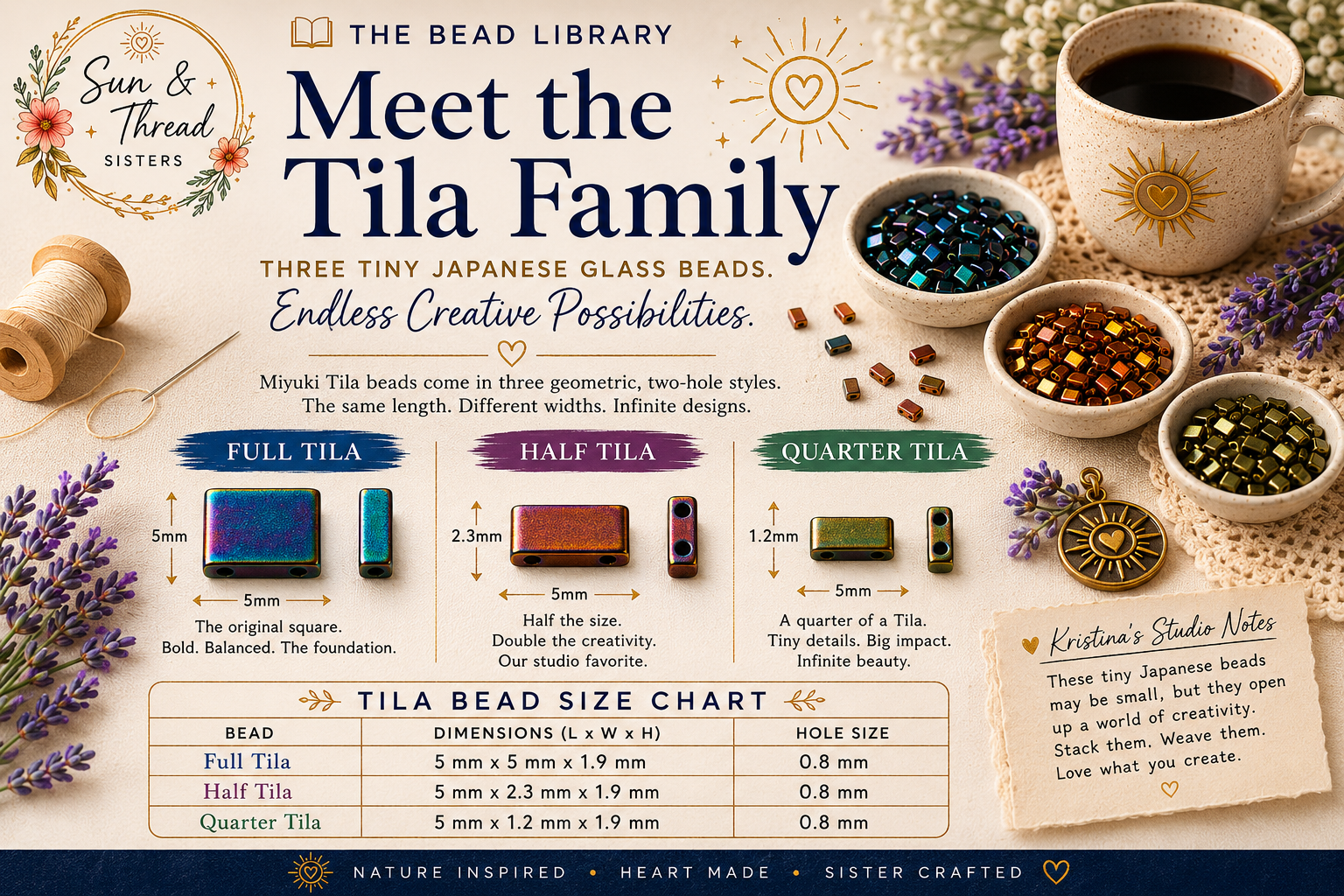
A story about Tila Beads
Pull up a chair and join us as we explore the remarkable Miyuki Tila bead family. From their fascinating history to their endless creative possibilities, discover why these tiny Japenese glass beads continue to inspire our jewelry and tutorials.
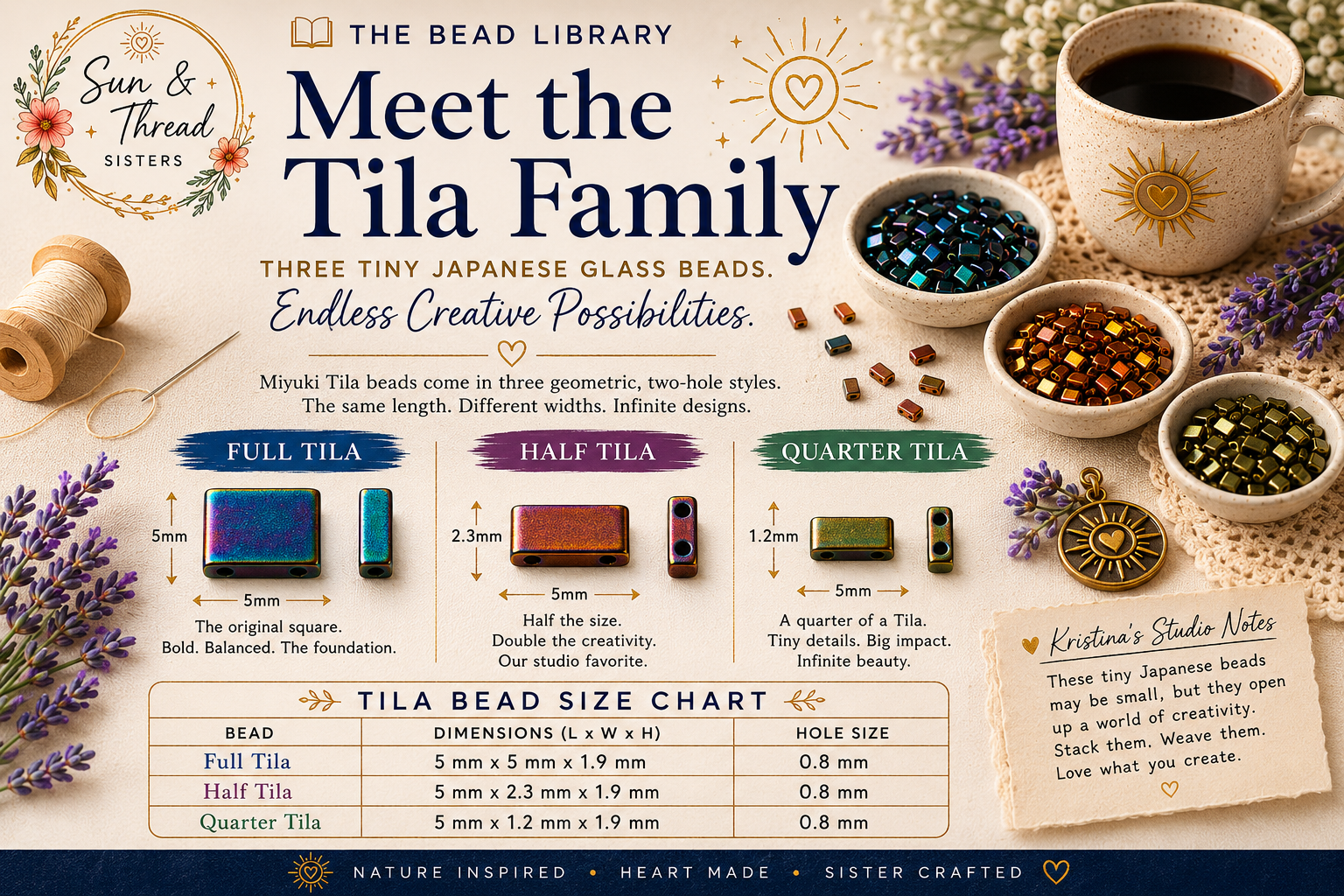
The Bead Library will be a continuing series exploring the history, beauty, and creative possibilities of the beads that inspire us.
"Pull up a chair, pour yourself a cup of coffee, and let's spend a little time talking about one of my favorite bead families."
There are some beads that quietly become part of your collection, and then there are beads that completely change the way you think about bead weaving.
For me, that bead was the Tila.
I still remember opening my very first package and pouring those tiny glass beads onto my bead mat. Instead of rolling around like traditional seed beads, they settled into neat little rows like miniature mosaic tiles, each one perfectly shaped and waiting to become something beautiful.
At first glance, they seemed wonderfully simple.
Flat.
Geometric.
Perfectly precise.
But as I picked one up and turned it over in my hand, I realized these weren't simply another bead—they were a completely different way of thinking about design.
The shape itself became part of the pattern.
That simple discovery opened an entirely new world of creativity, and ever since then, the Tila family has remained one of my favorite bead collections to work with.
Today I'd love to introduce you to these remarkable little beads and explain why they've become favorites of bead artists around the world.
A Little History
Every beautiful bead has a story.
The story of the Tila family begins in Hiroshima, Japan, where Miyuki has spent more than seventy-five years perfecting the art of manufacturing precision glass seed beads.
Founded in 1949, Miyuki earned a worldwide reputation for producing beads with extraordinary consistency. Every bead is carefully manufactured so artists can create smooth, balanced beadwork with remarkable precision.
In 2011, Miyuki introduced something completely new.
The original Tila bead.
Unlike traditional round seed beads, the Tila was designed as a flat square with two perfectly aligned holes. Inspired by the appearance of ceramic tiles, these innovative beads could be woven together into jewelry that looked more like fabric or mosaic art than traditional beadwork.
Designers immediately recognized the possibilities.
As artists experimented with the original Tila, they wanted even greater flexibility.
In 2016, Miyuki introduced the Half Tila.
By keeping the same five-millimeter length while reducing the width to just 2.3 millimeters, bead artists suddenly gained the ability to create flowing curves, intricate textures, increases, decreases, and beautifully woven designs.
Then, in 2017, the family was completed with the Quarter Tila.
At only 1.2 millimeters wide, this tiny bead added incredible detail and precision, making it perfect for borders, accents, and intricate finishing work.
Together, these three beads transformed modern bead weaving and continue to inspire artists across the world.
Meet the Family
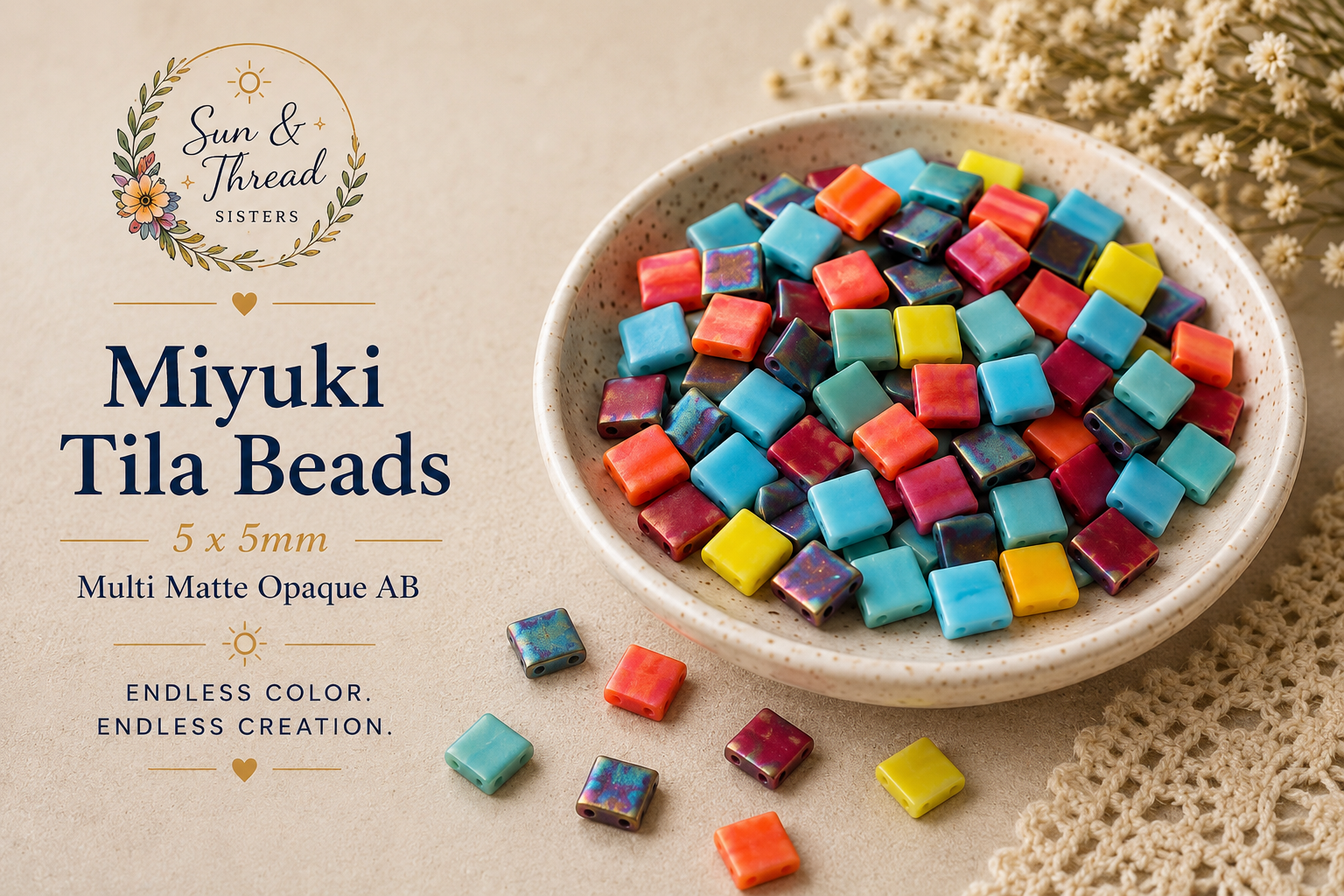
■ Full Tila
The original Tila measures 5 × 5 mm, creating a perfectly square, two-hole bead.
Its bold shape creates clean geometric lines and striking architectural designs.
I love using Full Tilas when I want a piece to feel balanced, structured, and contemporary.
They're ideal for:
• Statement bracelets
• Modern cuffs
• Mosaic-inspired jewelry
• Bold geometric designs
Think of the Full Tila as the foundation of the family—strong, confident, and beautifully balanced.
▭ Half Tila
If I had to choose my favorite member of the family, the Half Tila would probably win.
Measuring 5 × 2.3 mm, it keeps the same length as the original while becoming wonderfully flexible.
That simple change opens countless creative possibilities.
Half Tilas create movement.
Texture.
Soft curves.
Elegant woven surfaces that almost resemble fabric.
They're perfect for:
• Basket weave
• Herringbone-inspired designs
• Brick stitch combinations
• Layered textures
• Elegant bracelets and necklaces
Half Tilas are also the bead that inspired my own Half Tila Basket Weave Bracelet Tutorial. I love the way these tiny rectangles fit together like pieces of a mosaic, creating beautiful texture that changes with every color combination.
No matter how many times I use them, they continue to surprise me.
▪ Quarter Tila
The smallest member of the family measures just 5 × 1.2 mm, but don't let its size fool you.
Quarter Tilas are tiny details that often make the biggest difference.
They're wonderful for:
• Delicate borders
• Intricate accents
• Elegant spacers
• Fine detail work
• Combining beautifully with both Full and Half Tilas
Sometimes the smallest bead quietly brings an entire design together.
One Family. Three Shapes.
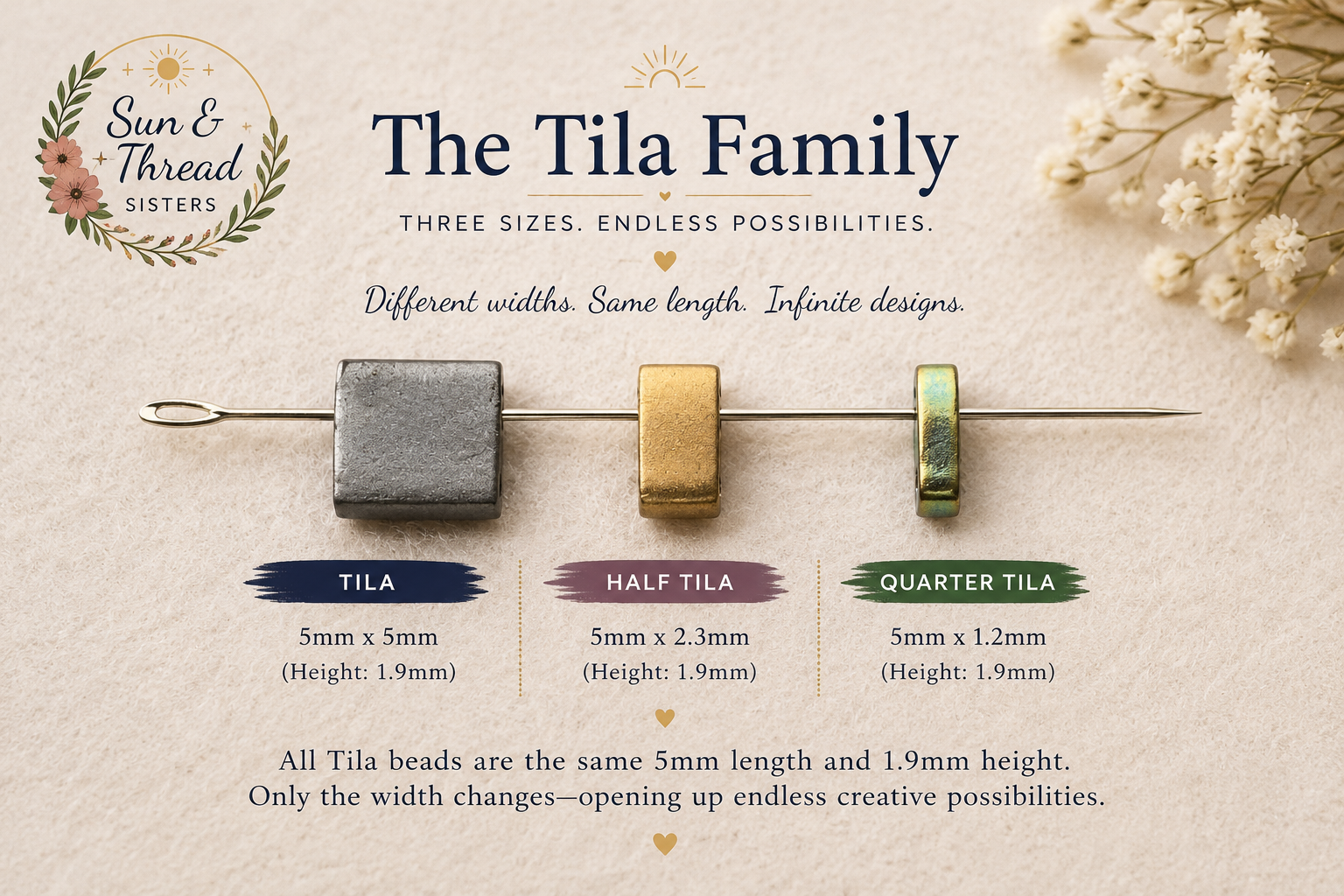
One of my favorite things about the Tila family is how thoughtfully they're designed.
Every bead shares the same:
• 5 mm length
• 1.9 mm thickness
• 0.8 mm hole size
Only the width changes.
BeadDimensionsFull Tila5 × 5 × 1.9 mmHalf Tila5 × 2.3 × 1.9 mmQuarter Tila5 × 1.2 × 1.9 mm
Because they're designed to work together, artists can easily mix all three sizes within the same project to create depth, movement, and beautiful architectural patterns.
Why I Love the Tila Family
One of the things I love most about these beads is that each size has its own personality.
The Full Tila makes a statement.
The Half Tila creates movement.
The Quarter Tila quietly fills the spaces that make a design feel complete.
Together, they remind me that beautiful beadwork isn't about using the biggest bead or the most expensive bead.
It's about understanding how each tiny piece contributes to something much greater.
As bead artists, we spend countless hours choosing colors, finishes, textures, and materials.
The Tila family reminds us that shape can be just as inspiring.
From Our Studio
One of the greatest joys of bead weaving is that every project begins with possibility.
Sometimes that possibility starts with a sketch.
Sometimes it starts with a color palette inspired by nature.
And sometimes...
It begins with a handful of beads scattered across a bead mat and a simple question.
"What happens if I try this?"
Those moments of curiosity have led to some of my favorite designs.
They're also the reason I continue learning, experimenting, and teaching.
Every finished bracelet, necklace, or piece of wearable art began as an idea waiting to be explored.
That's one of the reasons I love teaching.
Watching someone discover a new bead for the first time reminds me of why I fell in love with bead weaving in the first place.
☕ Coffee at the Worktable
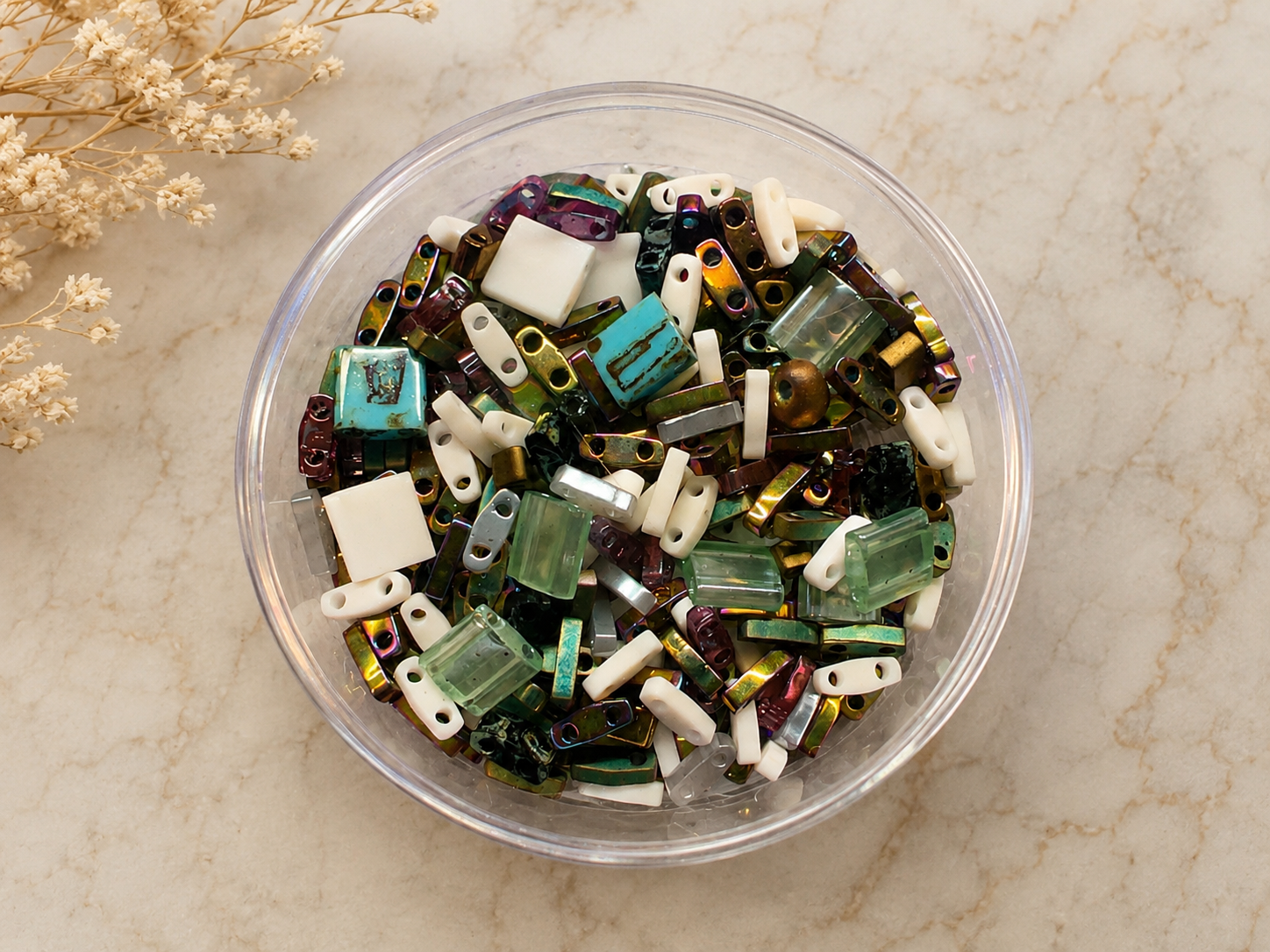
If you're just beginning your journey with Tila beads, don't feel like you need every color or finish before you start.
Choose a few that make you smile.
Spread them across your worktable.
Pick them up.
Turn them over in the light.
See how beautifully they fit together.
Some of my favorite designs have started with nothing more than a handful of Half Tilas, a needle, a spool of thread, a cup of coffee, and one simple thought:
"I wonder what would happen if I tried this?"
That's the magic of bead weaving.
The beads may stay the same...
But the possibilities never do.
Until Our Threads Cross Again...
Thank you for spending a little time with us in the studio today.
Whether you've been bead weaving for decades or you've just discovered the Tila family, we hope today's story inspired you to slow down, explore something new, and discover the beauty hidden in even the smallest details.
Our hope for The Sun & Thread Journal is simple—to create a place where artists, collectors, students, and curious makers can gather to learn, be inspired, and celebrate the remarkable world of beadwork together.
May your thread stay untangled, your needle easy to find, and your creativity always lead you somewhere unexpected.
With gratitude,
Kristina & Kimberly
Sun & Thread Sisters
Nature Inspired. Heart Made. Sister Crafted.