

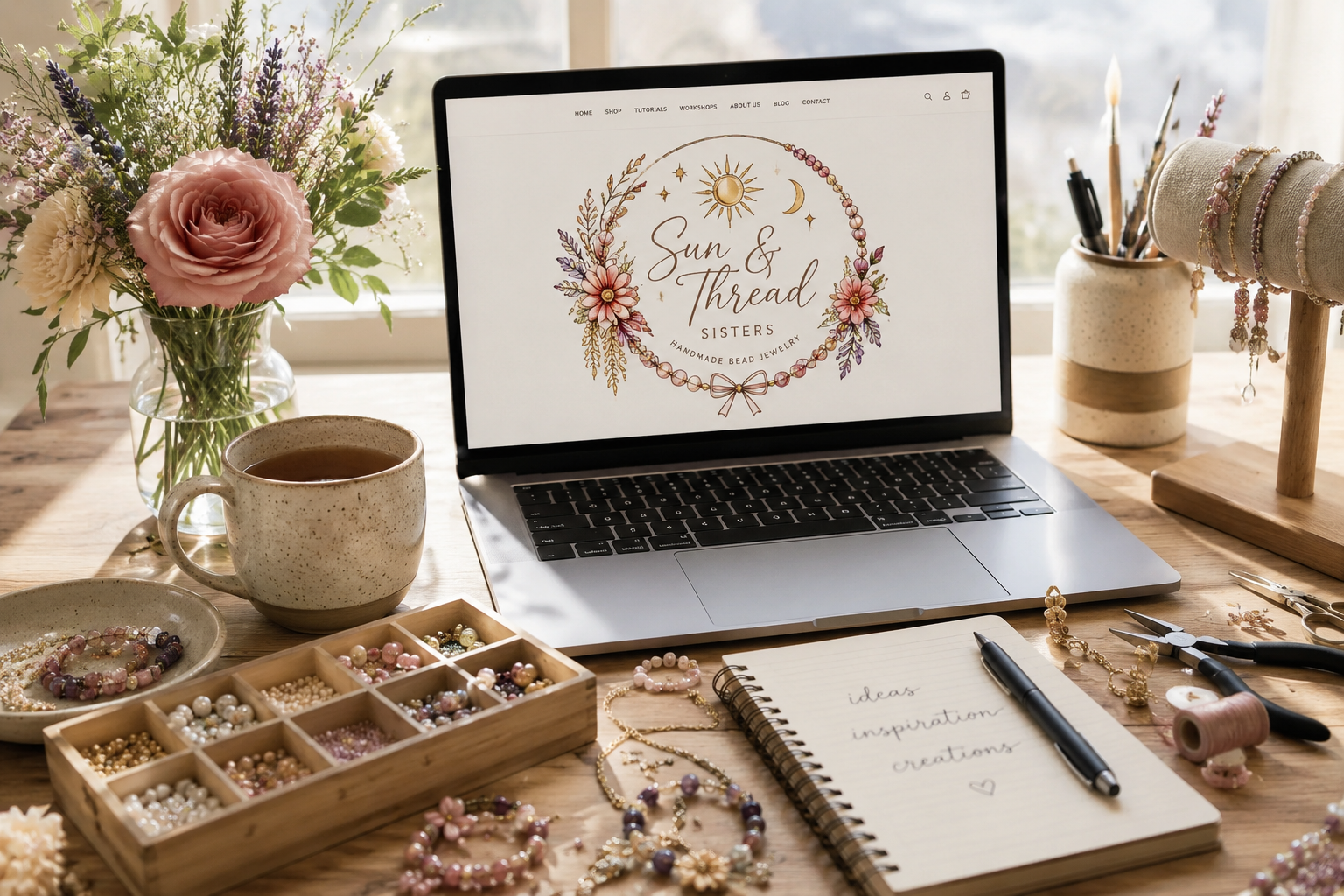
Sometimes the best designs aren’t planned at all. One beautiful bead, an unexpected color, or a little sparkle can lead the way—turning a table full of possibilities into something uniquely your own.
When the Beads Choose the Design
Sometimes I sit down at my bead table with a plan.
And sometimes the beads have an entirely different idea.
One beautiful bead catches my eye. Then I find another that looks just right beside it. A little sparkle gets added, then a seed bead, a pearl, or an unexpected color—and before long, the piece I thought I was going to make has become something completely different.
That is one of my favorite things about creating handmade jewelry.
Not every piece begins with a sketch or a carefully planned design. Sometimes it begins simply by opening a bead box, spreading a few possibilities across the table, and asking, What goes with this?
Color leads to texture. Texture leads to shape. One bead changes the direction of the next, and slowly a design begins to appear.
There are plenty of times when I take things apart, change my mind, replace a bead, or start over completely. That isn't wasted time. It's part of creating.
And every once in a while, all those little choices come together into something I never could have planned from the beginning.
Maybe that's part of what makes handmade pieces special.
They aren't simply assembled.
They evolve.
And sometimes, the best thing you can do is sit down with a table full of beads and see where they take you.
Until our threads cross again...
May your thread stay untangled, your needle easy to find, and your curiosity always lead you somewhere unexpected.
With gratitude,
Kristina & Kimberly
Sun & Thread Sisters
Nature Inspired • Heart Made • Sister Crafted.
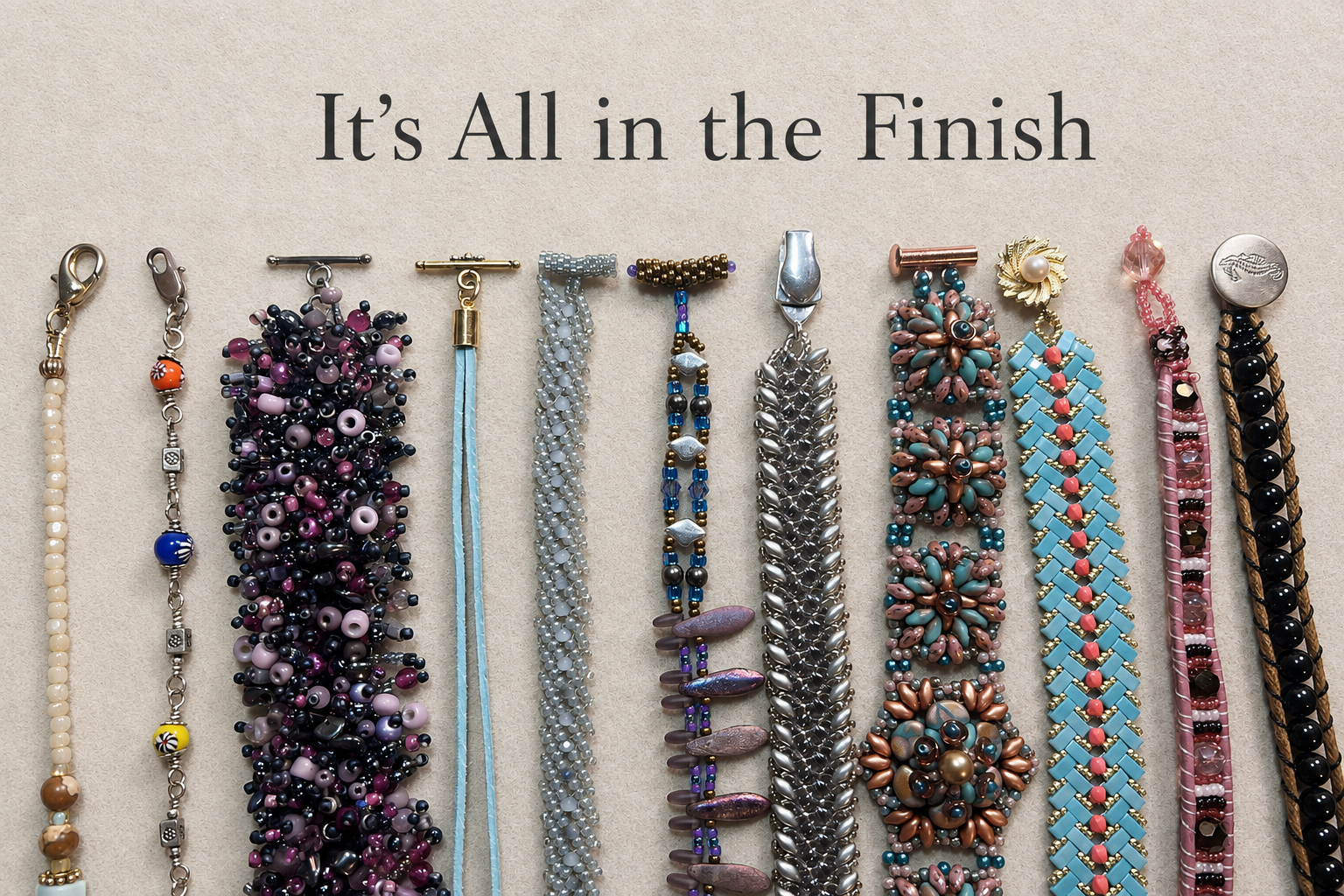
🧵✨ It’s All in the Finish
The finishing details of a handmade piece matter just as much as the beads themselves. From lobster and toggle clasps to magnetic and decorative closures, discover how the right finish brings comfort, function, and beauty together.
5 Ways to Give Your Handmade Jewelry a Beautiful, Secure Finish
Last week in the Journal, we talked about one of those little questions almost every new bead weaver eventually asks:
“Now what do I do with this thread?” 😄
We talked about weaving our working thread back through the beadwork, securing those beginning and ending tails, and why finishing beadwork isn’t really about finding one magical knot.
But thread is only one part of the story.
If you make jewelry long enough, eventually you’ll find yourself staring at a crimp tube, wire protector, tiny piece of French wire, jump ring, or unfamiliar clasp and thinking:
Okay…now what do I do with THIS? 😂
I’ve certainly been there.
The more I’ve learned about jewelry making, the more I’ve realized that knowing how to finish a piece is every bit as important as knowing how to begin one.
A beautiful necklace can have perfectly chosen beads. A bracelet can contain hours of careful bead weaving. But if the clasp isn’t attached securely, a crimp isn’t properly closed, or a thread isn’t protected at a stress point, all of that beautiful work can be at risk.
So today we’re moving beyond the thread and looking at five common ways jewelry makers finish their pieces.
1. 🔗 Crimps — Small but Mighty
A crimp may be one of the smallest components in a piece of jewelry, but it has one of the most important jobs. This tiny piece of metal secures the bead-stringing wire to the clasp and helps hold the entire design together. If the crimp fails, everything else can fail with it.
Crimps come as small, round crimp beads and longer, cylindrical crimp tubes. They are available in micro sizes, commonly used #2 and #3 sizes, and larger sizes for heavier wire or multiple strands. Each size requires the appropriate tool—micro, standard, or larger crimping pliers.
The correct crimp is determined by the diameter of the bead-stringing wire, not simply by whether the wire contains 7, 19, or 49 strands. The 49-strand wire shown here recommends either a #2 crimp bead or a #3 crimp tube. Other 49-strand wire diameters may require different sizes, so always check the wire package before choosing your crimp.
When closing a crimp, use the correctly sized crimping pliers and follow the directions for that particular tool. With standard crimping pliers, the crimp is first compressed in the forming station and then rounded in the rounding station. Before adding a crimp cover, give the wire a gentle tug to make sure the connection is holding securely.
This is also one place where quality matters. Cheap crimps may split, crack, flatten unevenly, or fail to grip the wire securely. The low-quality crimp shown in the photograph split when it was compressed instead of closing smoothly around the wire. Once a crimp cracks or separates, discard it—never reuse it or try to conceal the damage beneath a crimp cover.
Good-quality crimps are a small investment compared with the beads, materials, and time that go into a finished piece. A beautiful piece of jewelry is only as dependable as the tiny crimp holding it together.
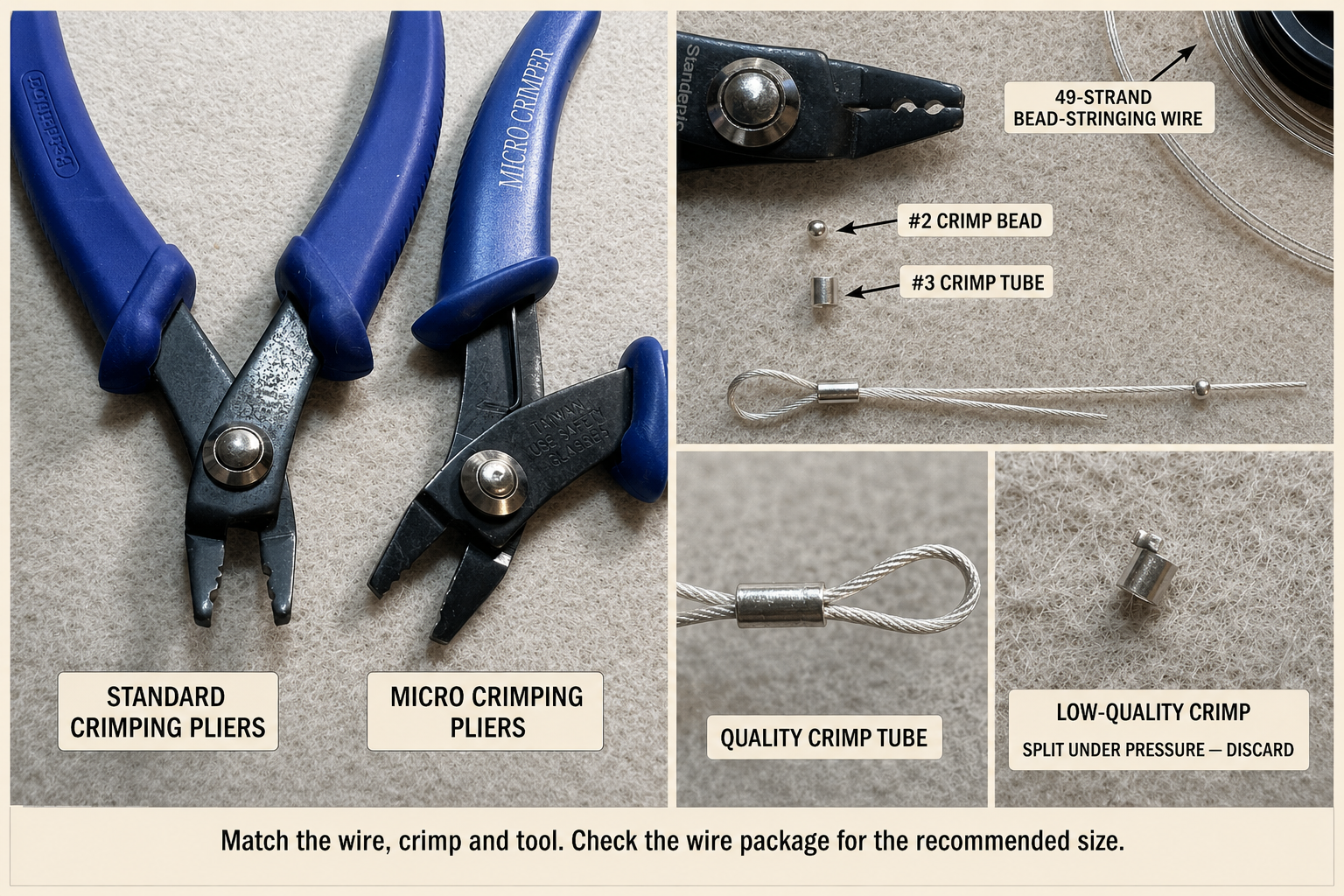
Close It, Round It, Test It
Use the correct crimp and the correctly sized tool. Form the crimp, round it, and finish with a gentle tug test before adding a crimp cover. That tiny connection can make all the difference.
2. 🛡️ Wire Protectors — Protecting the Vulnerable Spot
Here’s another tiny finding that makes much more sense once you understand what it does.
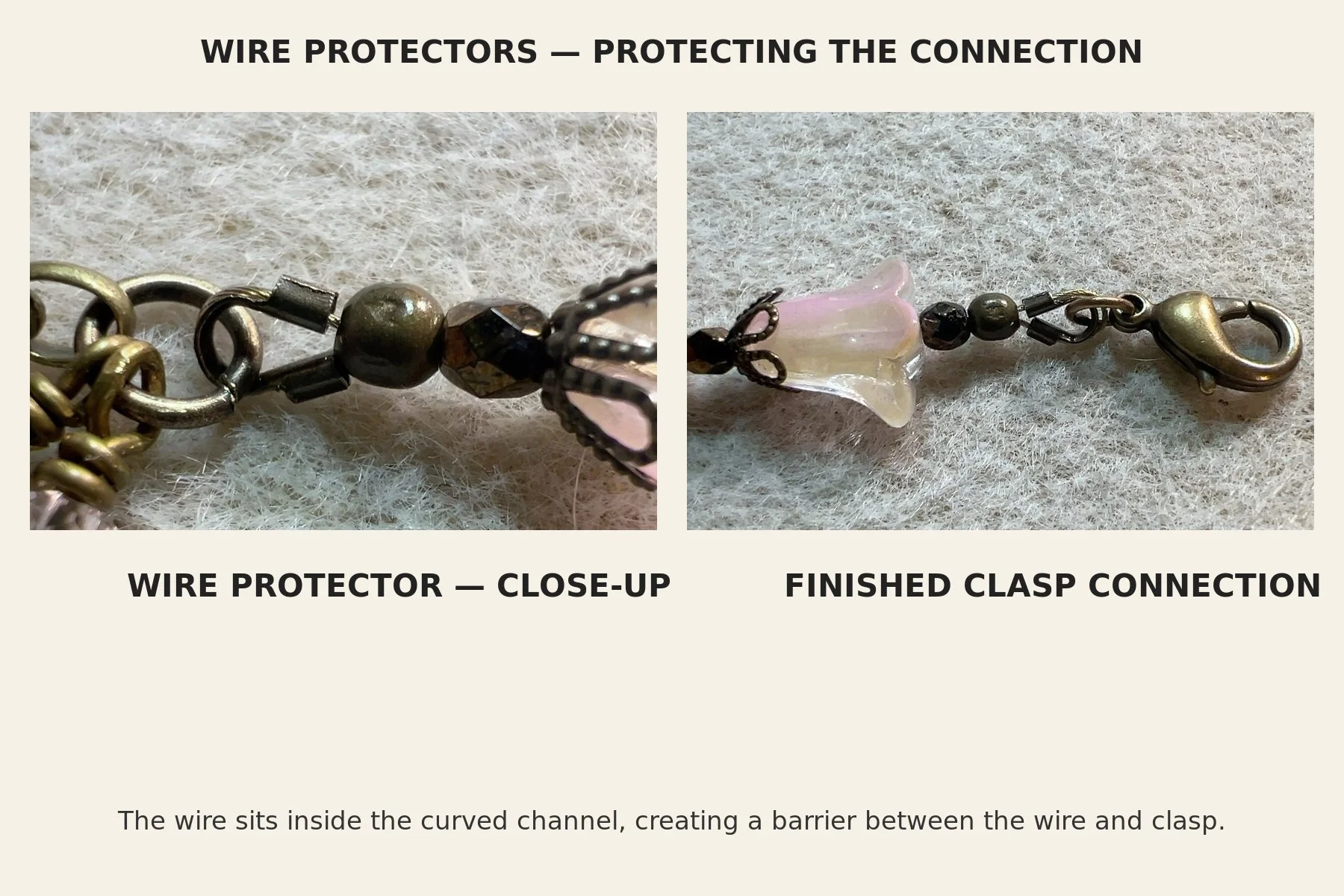
A wire protector, sometimes called a wire guardian, is the small horseshoe-shaped metal finding you may see between the bead-stringing wire and the clasp. The wire travels up one side, around the curved channel, and back down the other. The clasp or connecting ring rests inside that protected curve.
Why bother?
Every time you wear a bracelet or necklace, that connection point moves. Over time, repeated friction against a clasp or connecting ring can weaken exposed bead-stringing wire. A wire protector creates a smooth barrier between the wire and the metal connection.
To use one, guide the bead-stringing wire through the first opening, around the curved channel, and back through the second opening. Make sure the wire sits smoothly inside the channel without crossing, twisting, or being forced into place. The clasp or connecting ring can then be attached within the protected curve.
The crimp belongs below the wire protector, on the two wire ends—not inside the protector itself. Once the crimp is secured, give the connection a gentle tug test before trimming the excess wire or adding a crimp cover.
I love finishing details like this because they remind me that good jewelry construction isn’t always about what we can see. Sometimes it’s about protecting the parts we can’t.
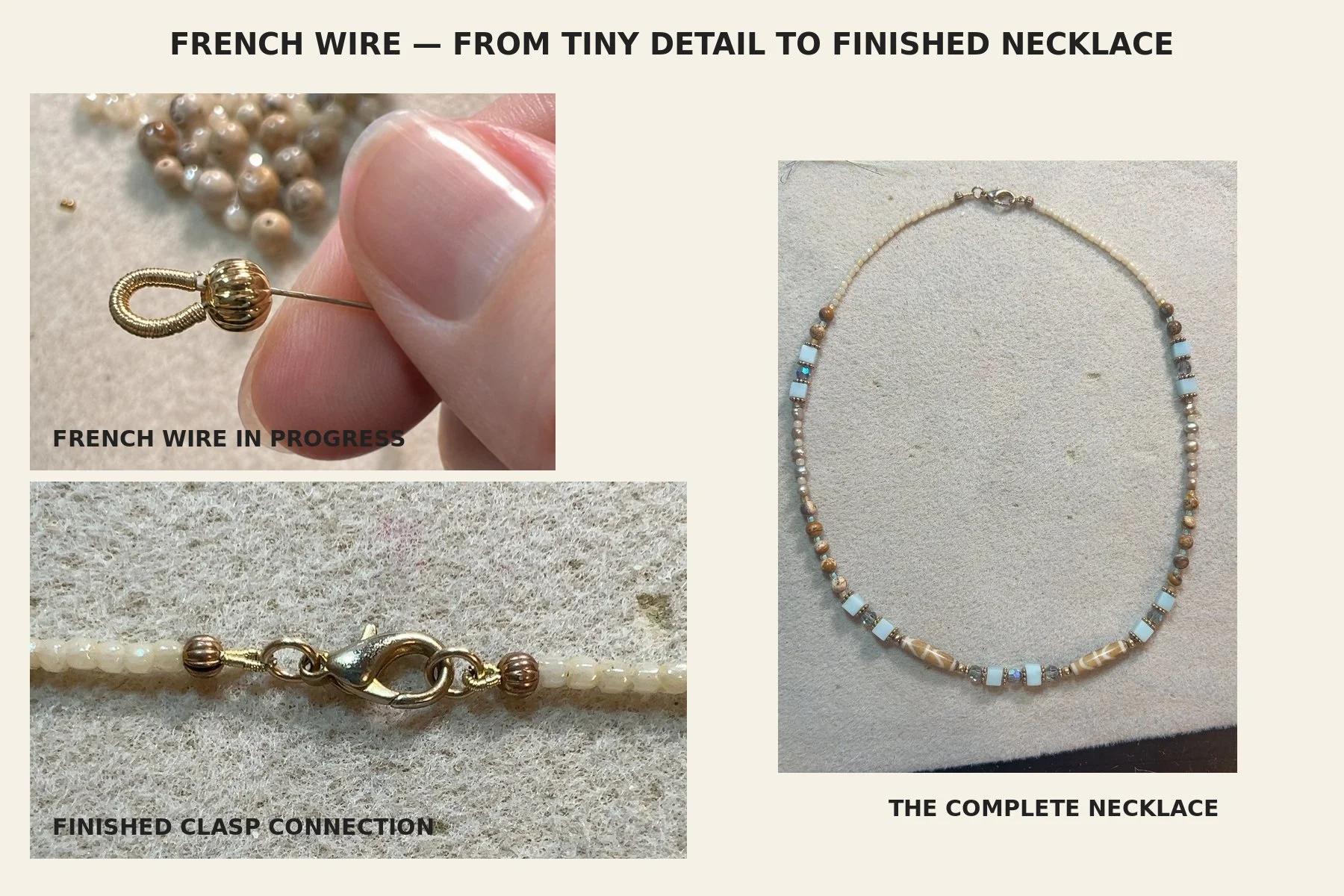
3. 🧵 French Wire — Tiny, Elegant, and Surprisingly Useful
The first time you see French wire, you might wonder what you’re supposed to do with that tiny metal coil.
French wire—also called bullion or gimp—is a very fine, hollow coil of metal traditionally used with thread or silk. It is not the same as bead-stringing wire. Instead, the thread passes through the center of the French wire, creating a small protective sleeve where the thread meets a clasp, jump ring, or other finding.
To use it, cut a short piece of French wire and slide it onto the working thread. Pass the thread through the clasp or connecting ring, then guide it back through the beadwork. As the thread is tightened, the French wire forms a neat little metal-covered loop around the connection.
French wire is delicate, so handle it gently. Avoid crushing, stretching, or pulling the coil apart. The finished loop should curve smoothly around the finding without gaps or sharp bends.
It is especially lovely for pearls, delicate necklaces, and traditional stringing techniques. The clasp touches the French wire rather than repeatedly rubbing against exposed thread, providing both protection and a beautifully polished finish.
It’s another tiny detail that does a great deal of work—protecting the thread while making the finished connection look intentional and elegant.
The French wire shown here belongs to one of my very favorite necklaces. I love the soft mix of pale aqua, warm cream, bronze, and pearl tones—and I love that such a tiny finishing detail helps protect the piece I enjoy so much.
4. 🪡 Woven Threads — Our Lesson From Last Week
Of course, we can’t talk about finishing jewelry without coming back to bead weaving.
Last week we went into this technique more deeply, but it’s worth remembering the basic idea:
Don’t simply knot your thread beside the last bead, snip it and hope for the best. 😉
Instead, weave your working thread back through the existing beadwork.
Follow the established thread path when possible. Change direction. Depending on the stitch, you may add a small half-hitch knot around an existing thread bridge and then continue weaving through additional beads before trimming.
And don’t forget that beginning tail!
Both ends deserve the same attention.
The strength comes from allowing the surrounding beadwork to help secure the thread rather than expecting one tiny knot to do all the work.
Missed last week’s Journal? Read How to Finish Your Beadwork: A Few Simple Tips for a closer look at weaving in and securing beginning and ending threads.
5. 🔨 Wrapped Loops, Jump Rings & the Final Connection
Then there’s wirework.
If you’re making beaded links, earrings, charms, pendants or wire-wrapped jewelry, a wrapped loop can create a beautiful and very secure connection.
The wire is formed into a loop and the remaining tail is wrapped neatly around the stem before being trimmed.
One lesson worth remembering:
If something needs to be permanently captured inside that loop, put it on BEFORE you finish wrapping the loop!
Ask me how jewelry makers learn that one. 😄
Jump rings are another tiny component that can make—or break—a finish.
One of the first things every jewelry maker should learn is how to open one correctly.
Rather than pulling the ends apart and distorting the circle, hold each side with pliers and twist the ends sideways. Add your component, then twist the ring closed again.
A properly closed jump ring should have little or no visible gap.
Another tiny detail.
Another very important connection.
This beautiful bracelet was handmade and gifted to me by my sister, Kimberly Herrod—an incredible creator whose carefully wrapped loops transform every bead into part of a beautifully connected whole.
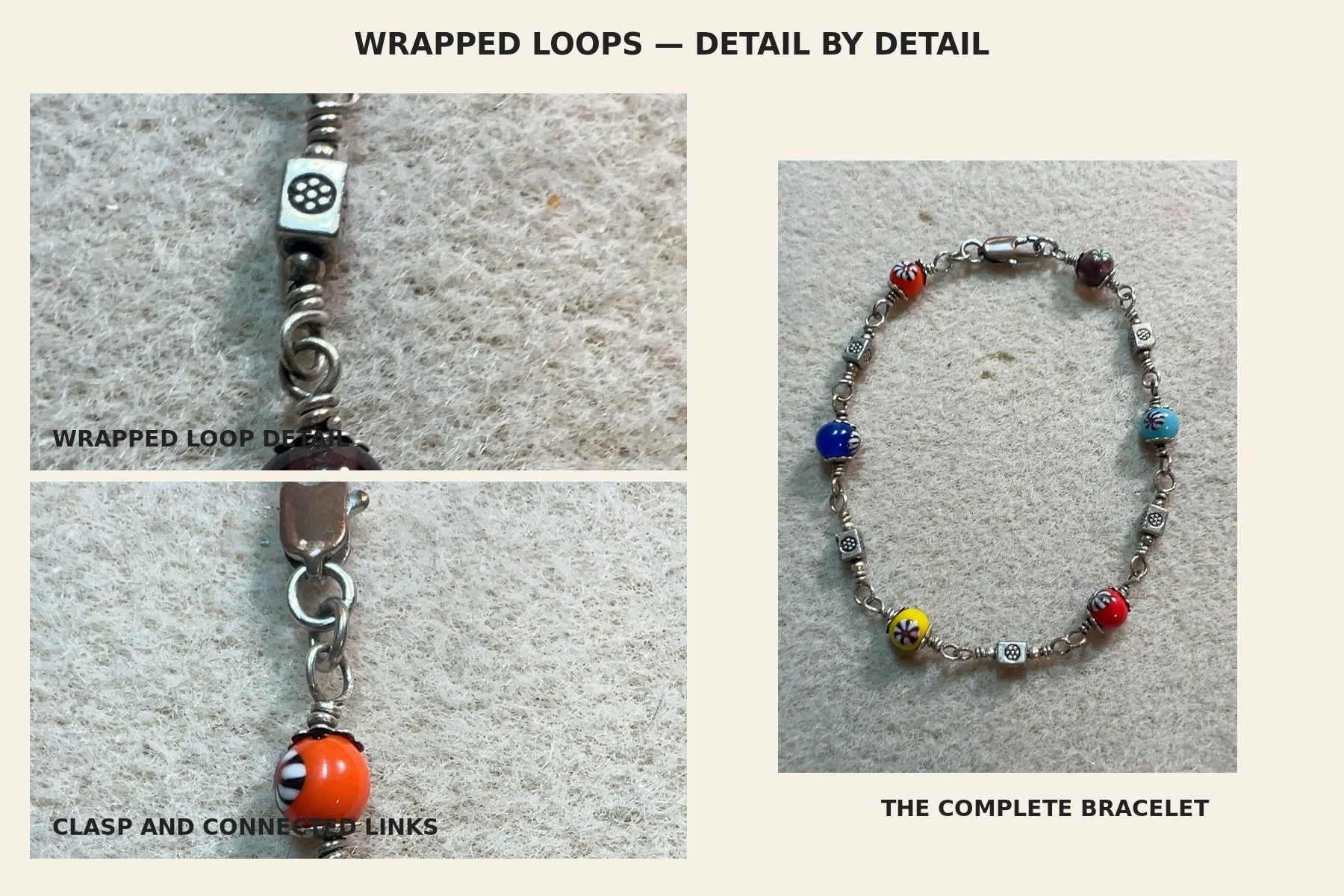
One of my favorite bracelets, handmade by my sister, Kimberly Herrod. Every wrapped loop becomes both a secure connection and part of the design.
And Then There’s the Clasp
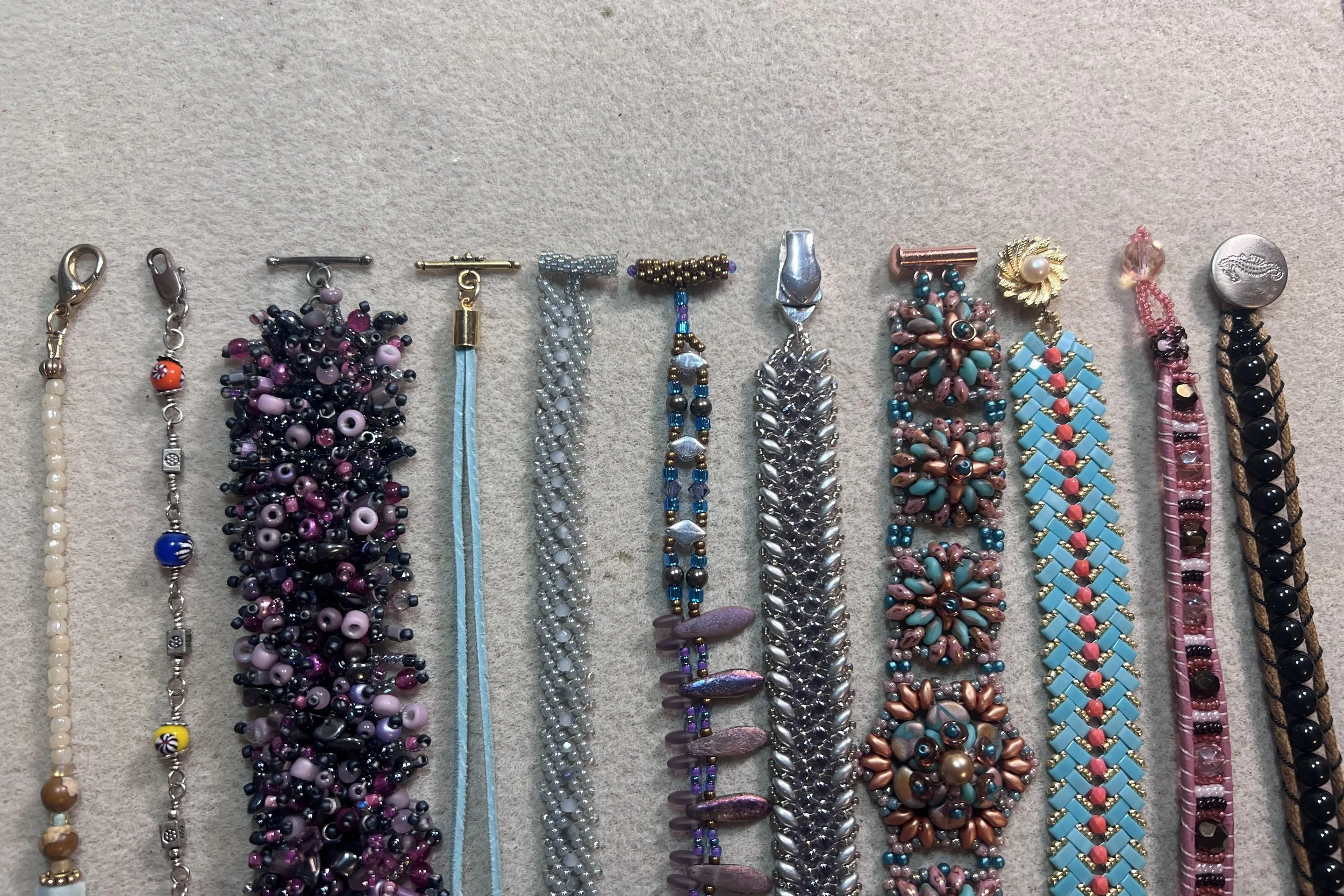
Once we understand how our material connects, we can choose the clasp that makes sense for the piece.
And there are so many choices.
Lobster clasps come in different shapes and make dependable everyday closures.
Toggle clasps are easy to use and can become a decorative part of the design themselves.
Magnetic clasps can make jewelry much easier to put on and remove.
Slide or tube clasps work beautifully with wide beadwork and multi-strand pieces.
Box clasps can add an elegant decorative finish.
Beaded loop and button-style closure becomes part of the design rather than something added at the very end.
Some closures are created specifically for the jewelry. A beadwoven toggle can coordinate perfectly with the surrounding beadwork, while leather ends may be finished with crimps and a decorative toggle.
The right clasp should complement the materials, feel comfortable for the wearer, and securely finish the piece. It may be the final component we add, but it should never be an
💜 The Finish Is Part of the Craftsmanship
I used to think of finishing as the thing you did after you made the jewelry.
Now I see it differently.
The finish is part of making the jewelry.
The crimp nobody notices.
The tiny piece of French wire protecting a strand.
The thread carefully woven back through the beadwork.
The jump ring closed without a gap.
The clasp chosen because it works beautifully with the piece.
They’re small things.
But together, they’re what allow something we’ve spent hours creating to actually be worn, loved and enjoyed.
Before I call a piece finished, I’ve learned to do four simple things:
I look. I feel. I tug. I wear.
Look closely at every connection.
Feel for sharp wire ends, rough edges or anything that might catch.
Gently tug the clasp and connection points.
Wear the piece and make sure it moves and feels the way it should.
Because finishing isn’t about reaching the end as quickly as possible.
It’s about respecting all the work that came before it.
How we finish something matters just as much as how we begin. 💜
🐇 A Little Further Down the Bead Trail
If you’re new to jewelry making, don’t feel as though you need to master every finishing technique at once.
Start with the technique that matches the type of jewelry you’re making.
Stringing on flexible beading wire? Learn to make a really good crimp.
Working with seed beads? Practice weaving those threads securely into your beadwork.
Beginning wirework? Get comfortable making wrapped loops and properly opening and closing jump rings.
And the next time you encounter a strange little finding in the bead aisle and wonder:
“What on earth am I supposed to do with THAT?”
Pick it up.
Learn about it.
Try it.
Because apparently there’s always one more tiny thing waiting to send us down another bead rabbit hole. 😄
Until our threads cross again… 🧵✨
May your thread stay untangled, your needle easy to find, and your creativity always lead you somewhere unexpected.
With gratitude,
Kristina & Kimberly
Sun & Thread Sisters
Nature Inspired • Heart Made • Sister Crafted.
How to Finish Your Beadwork: A few Simple Tips
You’ve picked your beads, found a pattern you love, and spent hours bringing your piece together. Then you get to the end and think:
Now what do I do with this thread?
Finishing a piece of beadwork can sometimes feel more intimidating than making it. When I first started beading, I worried that if I didn’t tie the perfect knot or finish the thread exactly right, the whole thing might come apart.
The good news is that finishing doesn’t have to be complicated.
Weave Your Thread Back Through
For many bead-weaving projects, one of the simplest ways to finish is to weave your working thread back through the beadwork.
Instead of cutting the thread right at the last bead, pass your needle back through several beads, following the existing thread path when possible. Change direction a couple of times as you work your way through the piece.
This helps secure the thread and keeps the end hidden inside your beadwork.
A Little Knot Can Help
Depending on the project and the stitch you’re using, you may also use a small knot between beads before weaving the remaining thread back through your work.
Keep the knot small and close to the beadwork so it disappears into the finished piece.
Don’t Forget the Beginning Thread
Remember that tail you left when you started?
It needs some attention too!
Thread it onto your needle and weave it back through the beadwork just as you did with your ending thread. Once everything feels secure, carefully trim the remaining thread close to the beads.
Give Your Piece a Gentle Check
Before you call it finished, take a minute to look everything over.
Gently move the piece in your hands. Check your clasp or connection points and make sure you don’t see any loose threads.
Then comes one of my favorite parts:
Hold it up and look at what you made.
Finishing your beadwork isn’t about making one magical knot. It’s about securing your thread, hiding your ends, and making sure the piece is ready to be worn and enjoyed.
And like almost everything in beading, it gets easier with practice.
Until our threads cross again… 🧵✨
May your thread stay untangled, your needle easy to find, and your creativity always lead you somewhere unexpected.
With gratitude,
Kristina & Kimberly
Sun & Thread Sisters
Nature Inspired • Heart Made • Sister Crafted.
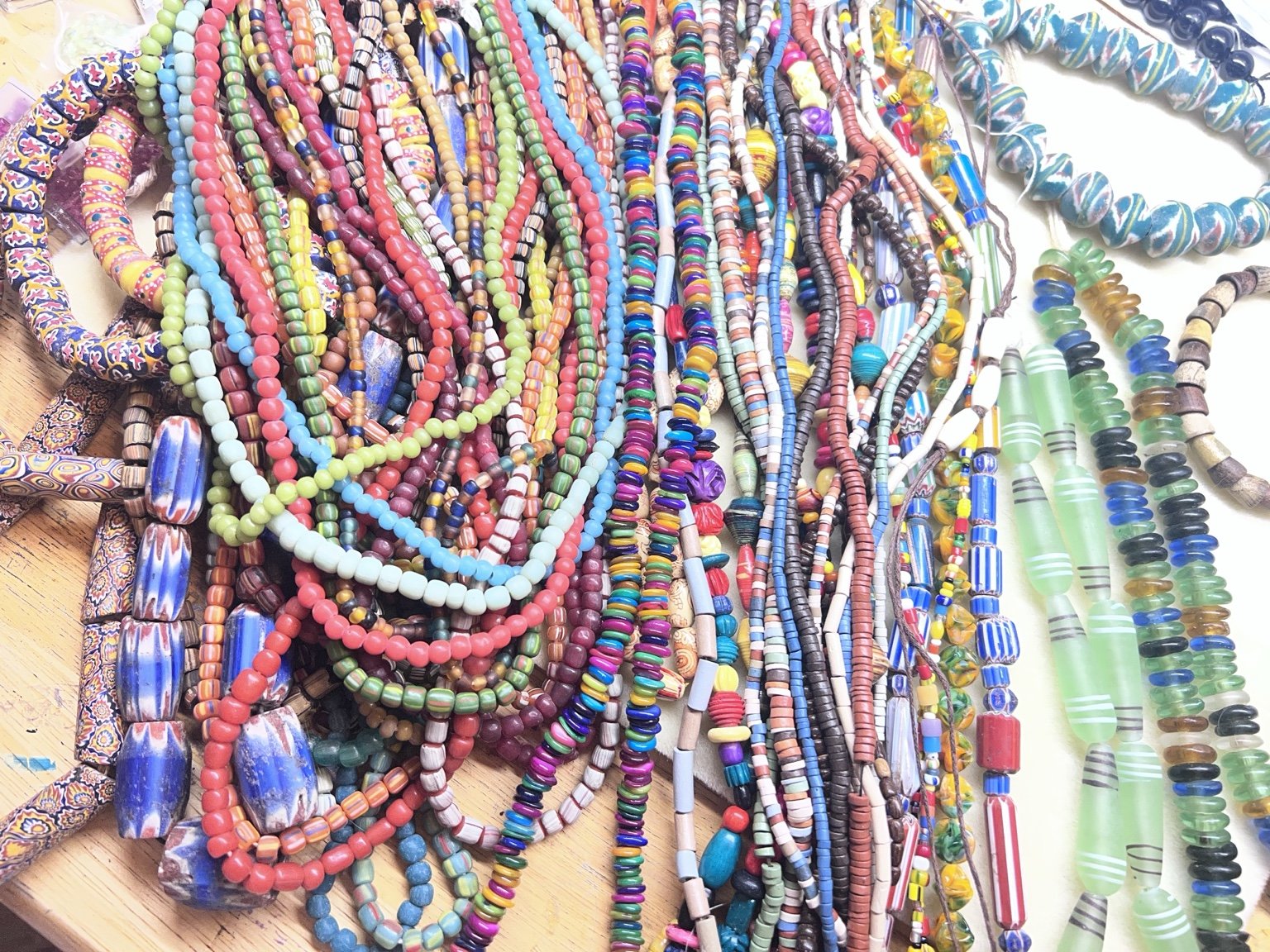
📖 THE BEAD LIBRARY 🌍More Than a Bead: Africa, Trade & the Stories Beads Carry
What began with one unforgettable presentation became a story I couldn’t stop thinking about. Discover how Melony MacDuffee and the women of the Soul of Somanya cooperative in Ghana are transforming traditional beadwork into opportunity, independence, and hope—and why their story has stayed with me ever since.
Bead Library 8/11/2026
I have a confession.
Give me a table covered in old, unusual, colorful beads and I can disappear for a very long time. 😊
I want to pick them up. Turn them over. Look at the wear around the holes. Wonder how they were made, where they came from, how old they might be—and how many hands may have held them before mine.
This week I have an especially good reason to wander back down that particular rabbit hole.
The Rocky Mountain Bead Society Mini Challenge is inspired by Africa, and it immediately brought me back to a subject I've enjoyed learning about before: African beadmaking, trade beads, and the remarkable history connected to these tiny objects.
Once you begin looking into that history, you quickly discover something.
A bead is almost never just a bead.
🌿 Before There Were “Trade Beads”
When we hear the words African trade beads, it's easy to picture colorful glass beads arriving on ships from Europe.
But that's only one chapter of a much longer story.
Africa had rich traditions of personal adornment and beadmaking long before European trade beads entered the picture. Archaeological discoveries in South Africa include pierced shells used for adornment tens of thousands of years ago.
Across an enormous continent filled with many different peoples and cultures, beads and ornaments have been created from shell, stone, clay, bone, coral, metal, glass and other materials.
And depending upon the community, place and time, beads could mean far more than decoration.
They could be connected to identity.
Status.
Relationships.
Spiritual beliefs.
Community.
Celebration.
And tradition.
It's also important to remember that there isn't one single thing called “African beadwork.”
Africa is extraordinarily culturally diverse, and its bead traditions differ from one region and community to another.
That's part of what makes learning about them so fascinating.
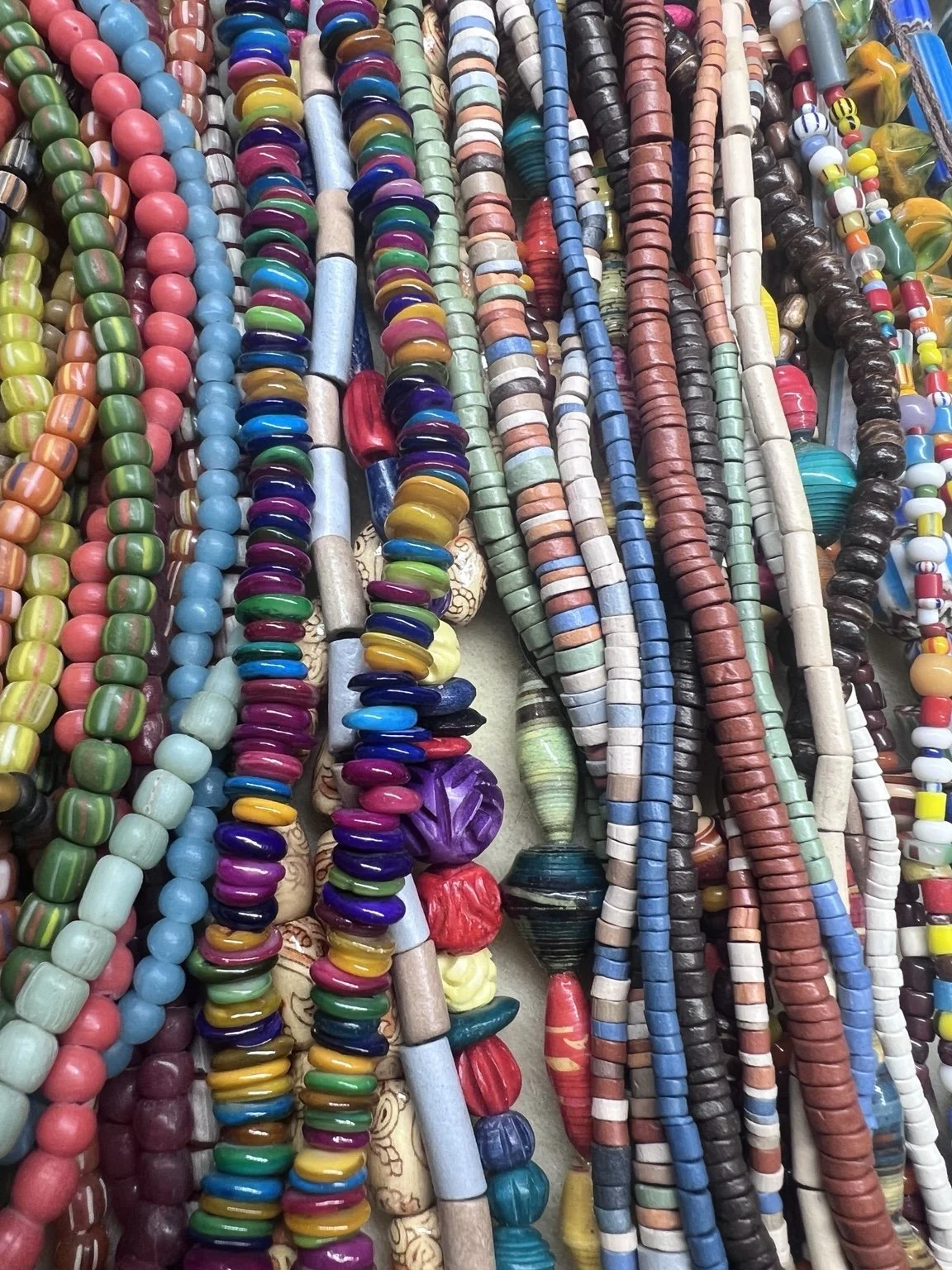
🌍 Then the Beads Began to Travel
Beads may be tiny, but they turned out to be wonderful travelers.
They're small.
They're durable.
They're relatively easy to transport.
And humans have valued beautiful and unusual materials for a very long time.
Long-distance trade connected African societies with other parts of the world centuries before modern European colonial expansion. Archaeological study of glass beads has even helped researchers trace trade networks connecting eastern and southern Africa with the wider Indian Ocean world.
Later, European-made glass beads became an increasingly important part of global commerce.
Venice—and particularly Murano—became one of the great centers of glass-bead production, manufacturing extraordinary varieties of beads that traveled around the world.
Other European glassmaking centers eventually participated as well.
This is where the term trade bead becomes interesting.
Many beads we casually refer to today as African trade beads weren't necessarily manufactured in Africa. Some were made in Europe and traveled into African markets, where they entered existing systems of commerce, adornment and artistic expression.
But African artisans were—and remain—beadmakers themselves.
Communities including Krobo beadmakers in Ghana developed distinctive traditions of creating beautiful glass beads, including beads produced from recycled glass.
So this isn't simply a story about Europeans bringing beads to Africa.
It's a story of movement, exchange, craftsmanship, adaptation and people giving materials meaning.
❤️ The Presentation That Made Me Want to Know More
My own interest in African beads and beadwork became much more personal after hearing jewelry artist, author and teacher Melody MacDuffee speak during a presentation last May.
I had seen African beads before, of course.
I had admired their colors, patterns, textures and wonderfully imperfect character.
But listening to Melody tell the stories behind the beads—and, more importantly, the people making them—made me want to know more.
Melody is the co-founder of Soul of Somanya, a nonprofit whose story began with a rather extraordinary email.
In 2007, Melody was contacted on behalf of bead artisans in the Krobo region of Ghana who asked if she would come and teach additional jewelry-making techniques.
These were already skilled artisans creating the distinctive recycled-glass beads for which the region is known.
Melody traveled to Ghana to share what she knew—and to learn from them as well.
What began as a teaching trip eventually grew into Soul of Somanya, founded by Melody and Ghanaian artisan Arkuh Bernard Tettey, with a mission centered on creating dependable, living-wage handcraft employment and economic opportunities.
There was something about hearing Melody tell those stories in person that stayed with me.
Suddenly the beads weren't simply beautiful objects.
There were makers behind them.
Families.
Communities.
Skills passed from one generation to another.
And a contemporary story that is still being written today.
I think that's when my curiosity really took hold.
Instead of only looking at a bead and wondering,
What could I make with this?
I began wondering:
Where did this come from?
Who made it?
How was it made?
What story did it already carry before it ever reached my bead mat?
That presentation deepened my interest in African beads and my desire to learn more about the cultures, makers and history surrounding them.
And I'm still learning.
Maybe that's one of the things I love most about beads.
The more you learn about them, the bigger their world becomes. 🌍❤️
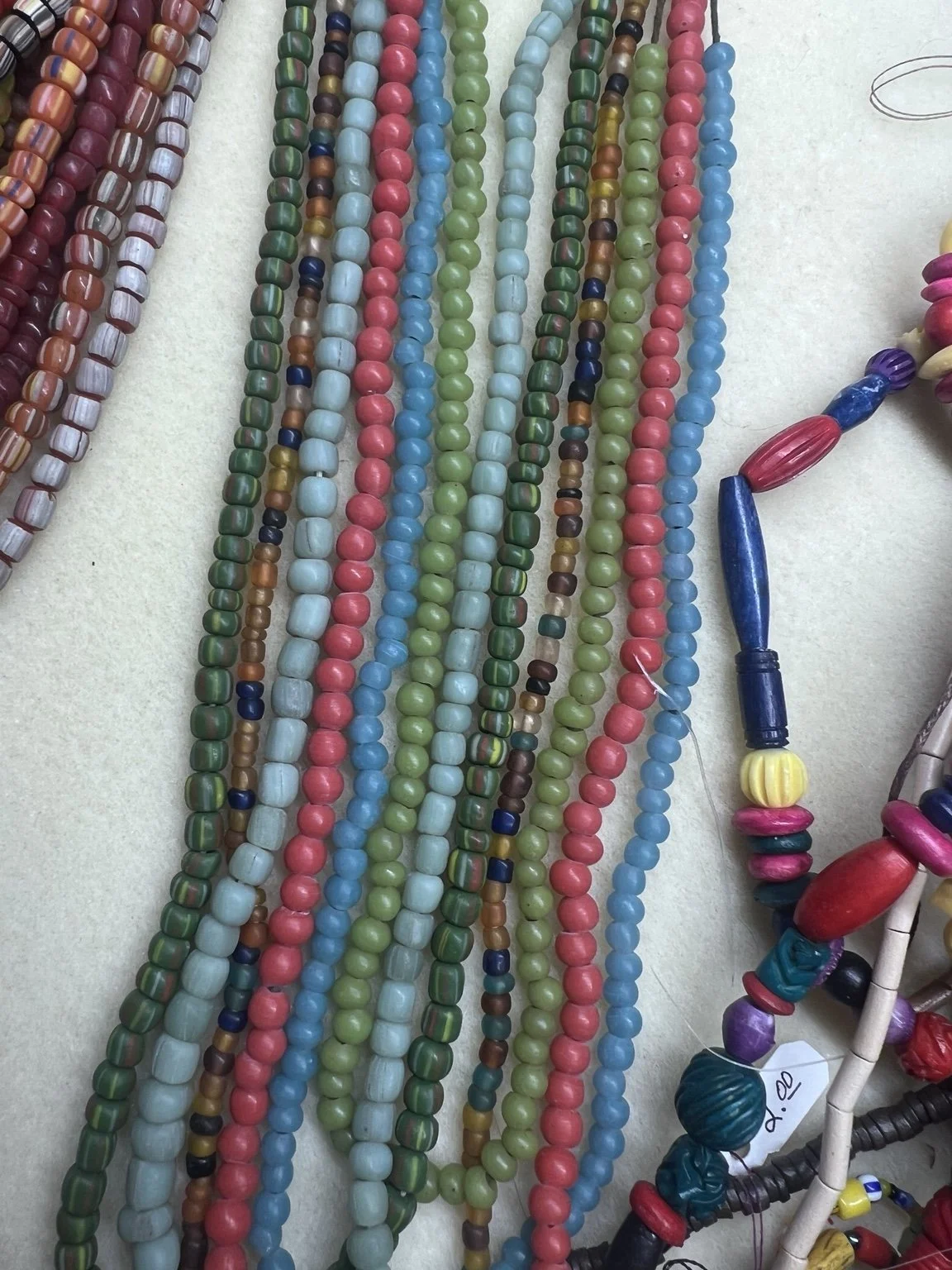
Part of my own bead collection. Some have known origins; others still have stories I'm learning to uncover.
❤️ Not Every Part of the Story Is Beautiful
As much as I love the artistry and history surrounding beads, we can't talk honestly about historic global trade without acknowledging that some parts of that history are difficult.
As European commercial expansion in Africa grew, trade became entangled with colonialism, exploitation and the transatlantic slave trade.
Beads were among many commodities that circulated within those systems.
I don't think acknowledging that history takes anything away from appreciating the artistry of these objects.
If anything, it reminds us that the materials we hold can have complicated histories.
Learning about those histories gives us an opportunity to approach them with greater understanding and respect.
🧵 When Beads Become a Language
Something else fascinates me.
The story doesn't end when a bead reaches its destination.
That's where another story begins.
Artists incorporated glass beads into existing traditions and transformed them through their own designs, techniques and cultural meanings.
In different African communities, beadwork has been used to communicate aspects of identity, social standing, relationships, age, ceremony and belonging.
And although the traditions are very different, I think bead artists today can understand something about that instinct.
We still give beads meaning.
We choose a color because it reminds us of someone.
We save a special bead because it came from a friend.
We incorporate something old into something new because we can't bear to let it disappear.
We make jewelry to celebrate births, weddings, friendships, memories and milestones.
Sometimes we simply choose a bead because something about it speaks to us.
The materials and traditions may be different.
But that very human desire to tell stories through the things we make continues.
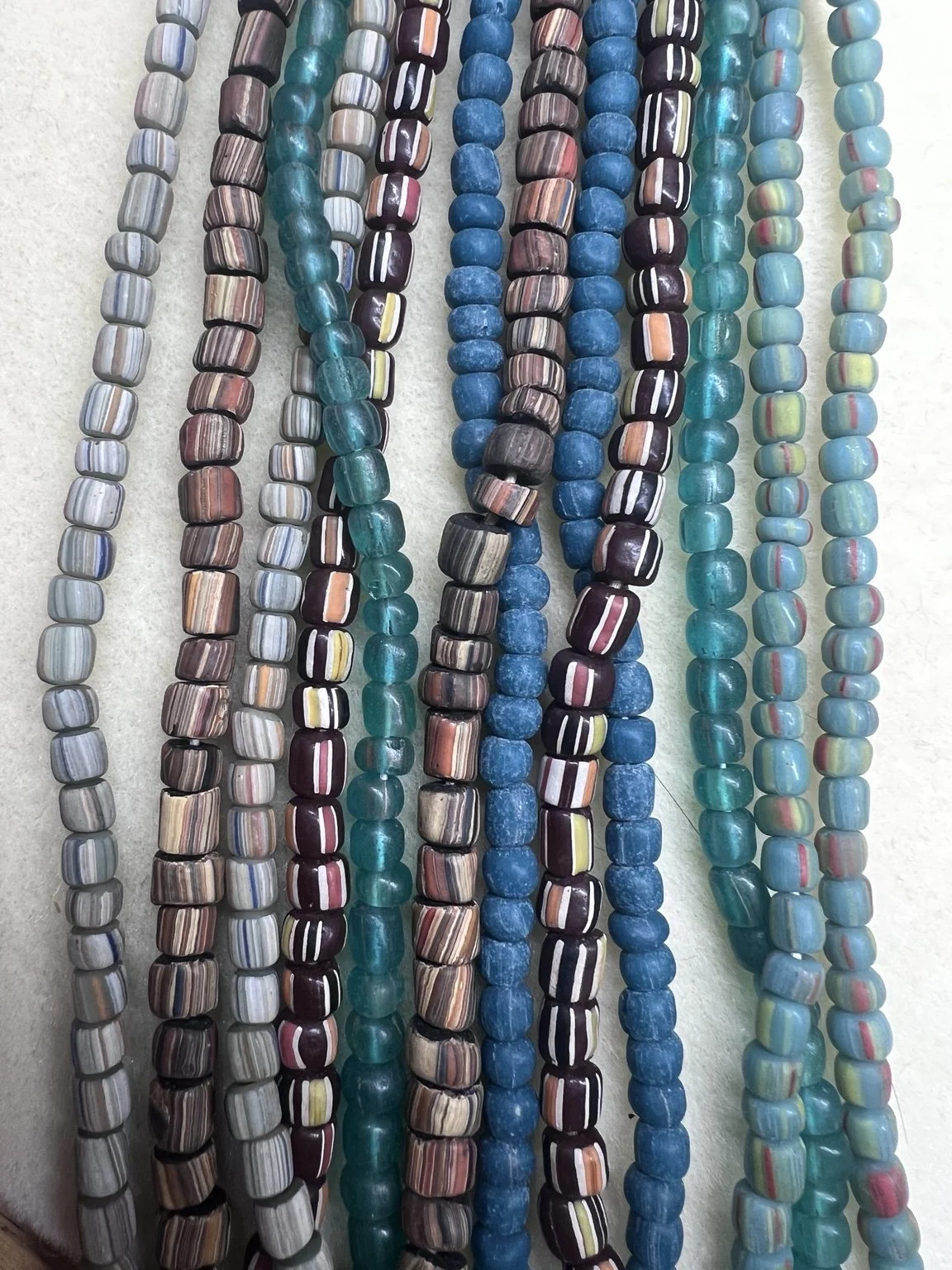
🔎 But Is It Really an African Trade Bead?
This may be one of my favorite lessons from learning about old beads:
Be careful what you claim to know. 😂
It can be very tempting to pick up an old-looking, wonderfully worn bead and immediately give it an equally wonderful history.
"This must be an antique African trade bead!"
Maybe.
But maybe not.
Age, manufacturing technique, country of origin and actual provenance can be surprisingly difficult to establish simply by looking at a bead.
Some beads being sold today are genuinely old.
Others are contemporary beads made using traditional techniques.
Some are reproductions inspired by historic designs.
And sometimes we simply don't know.
Even museum collections contain beads whose precise histories aren't completely documented.
I actually love that.
Because it means curiosity is perfectly acceptable.
Sometimes the most accurate thing we can say about a bead is:
“I don't know yet.”
And then we get to learn. ❤️
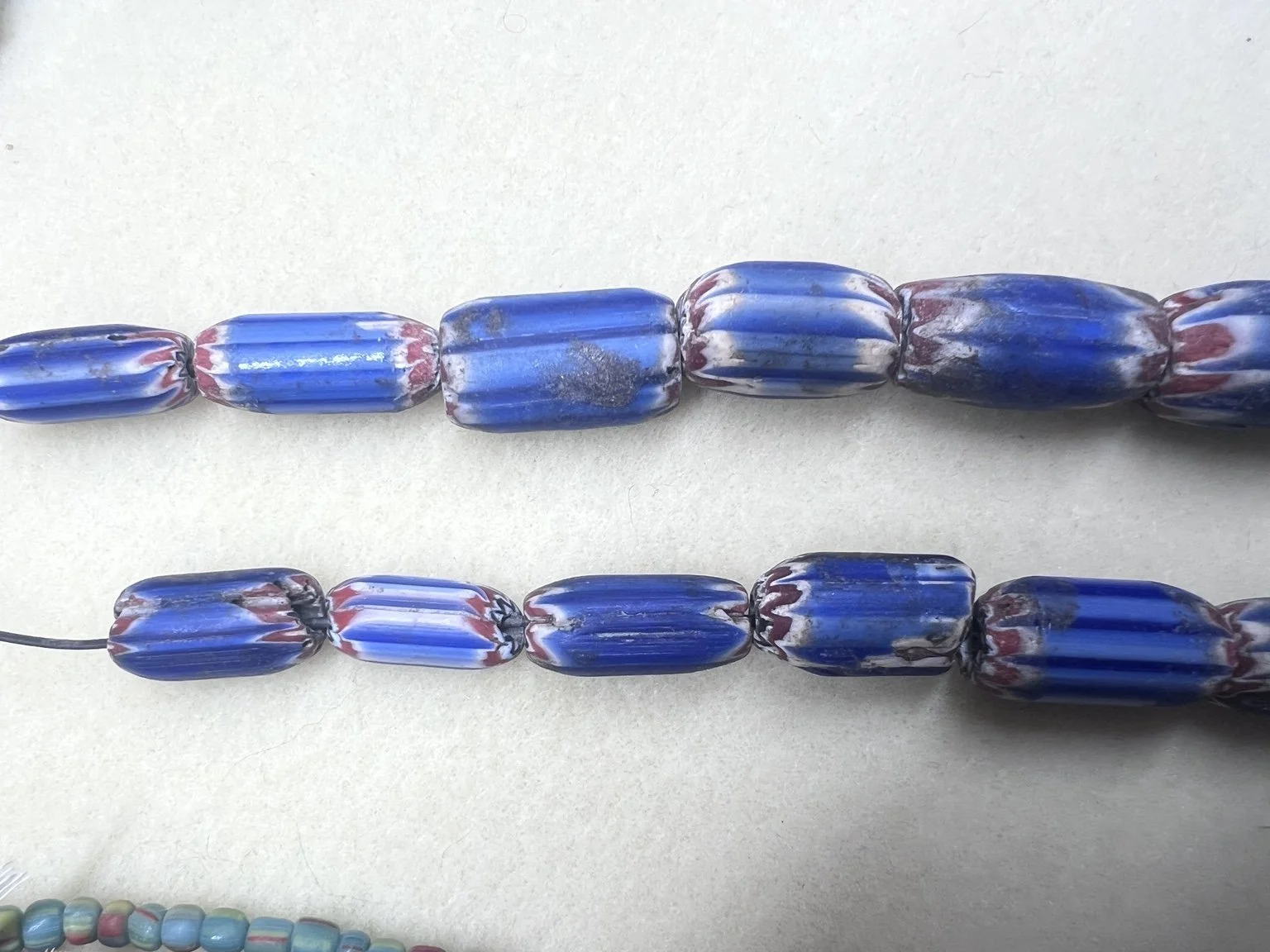
Beautiful? Absolutely. But appearance alone isn't enough to establish the age or complete history of a bead.
✨ Why These Beads Speak to Me
If you've been following Sun & Thread Sisters lately, you may have noticed that perfect doesn't interest me nearly as much as character does.
Give me variations.
Give me slightly uneven shapes.
Give me worn surfaces.
Give me colors that aren't perfectly identical.
Give me a bead that makes me wonder where it has been.
That's especially true when I'm doing bead embroidery.
I'll often spread beads around a piece and simply look at them for a while.
One color leads to another.
One texture changes the direction.
And sometimes one unusual bead suddenly becomes the thing around which the entire piece develops.
Knowing even a little about a bead's history changes the way I see it.
It stops being simply:
What can I make with this?
Instead I begin thinking:
What story am I adding to the one this bead already carries?
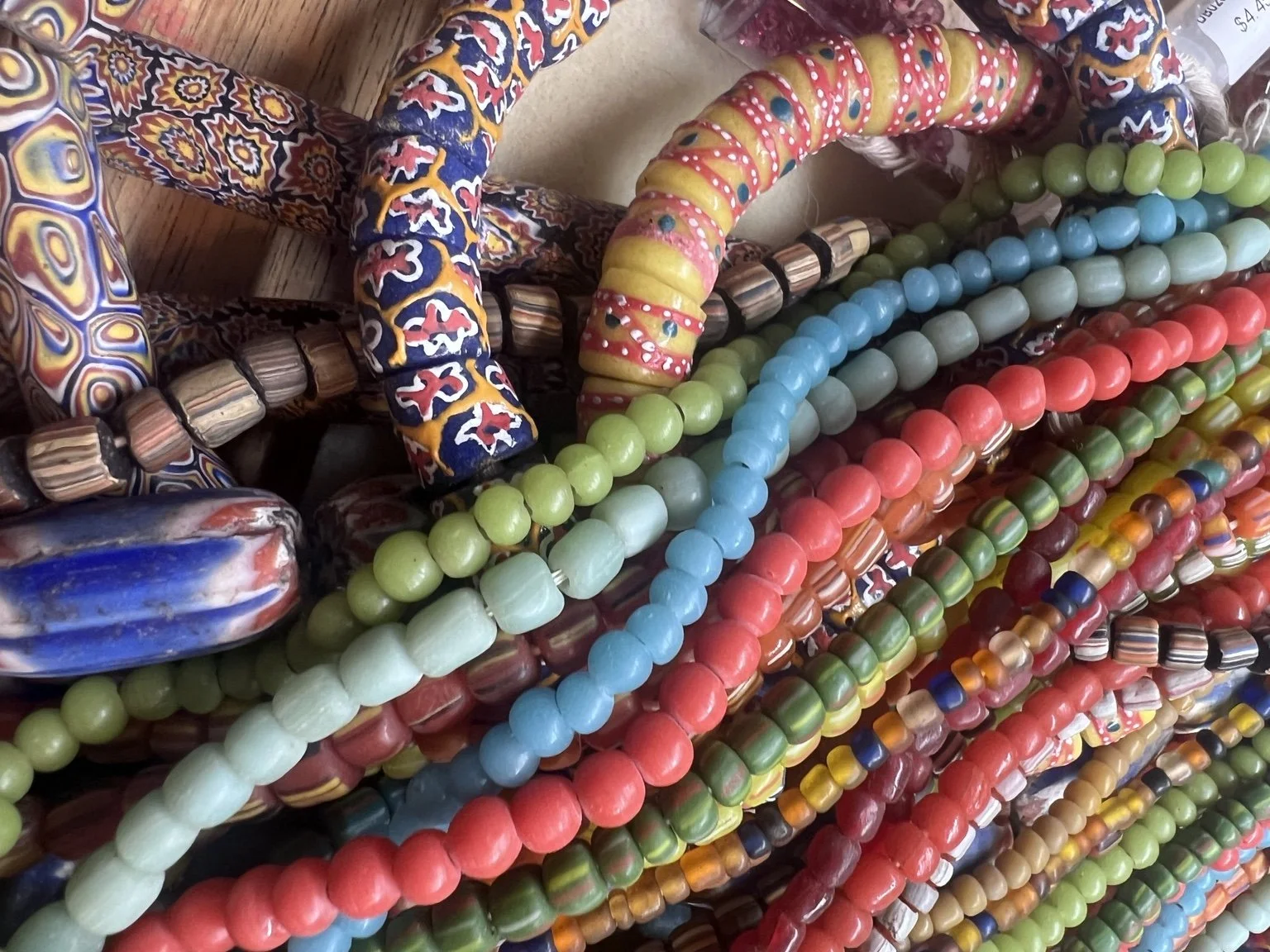
🌍 From Africa to the Bead Mat
That's one reason I'm looking forward to seeing what everyone creates for the Rocky Mountain Bead Society Mini Challenge.
An Africa-inspired theme gives us an opportunity to do more than simply reach for a particular color palette.
It gives us a reason to look deeper.
What traditions inspire us?
Where did a particular bead originate?
Who made it?
How was it made?
Is it old—or simply created in an older style?
What do we actually know about it?
And how can we be inspired by another culture thoughtfully and respectfully while still creating something that reflects our own artistic voice?
Those are questions I'm still learning to ask.
And I think asking them makes us better artists.
🧵 Every Bead Has a Beginning
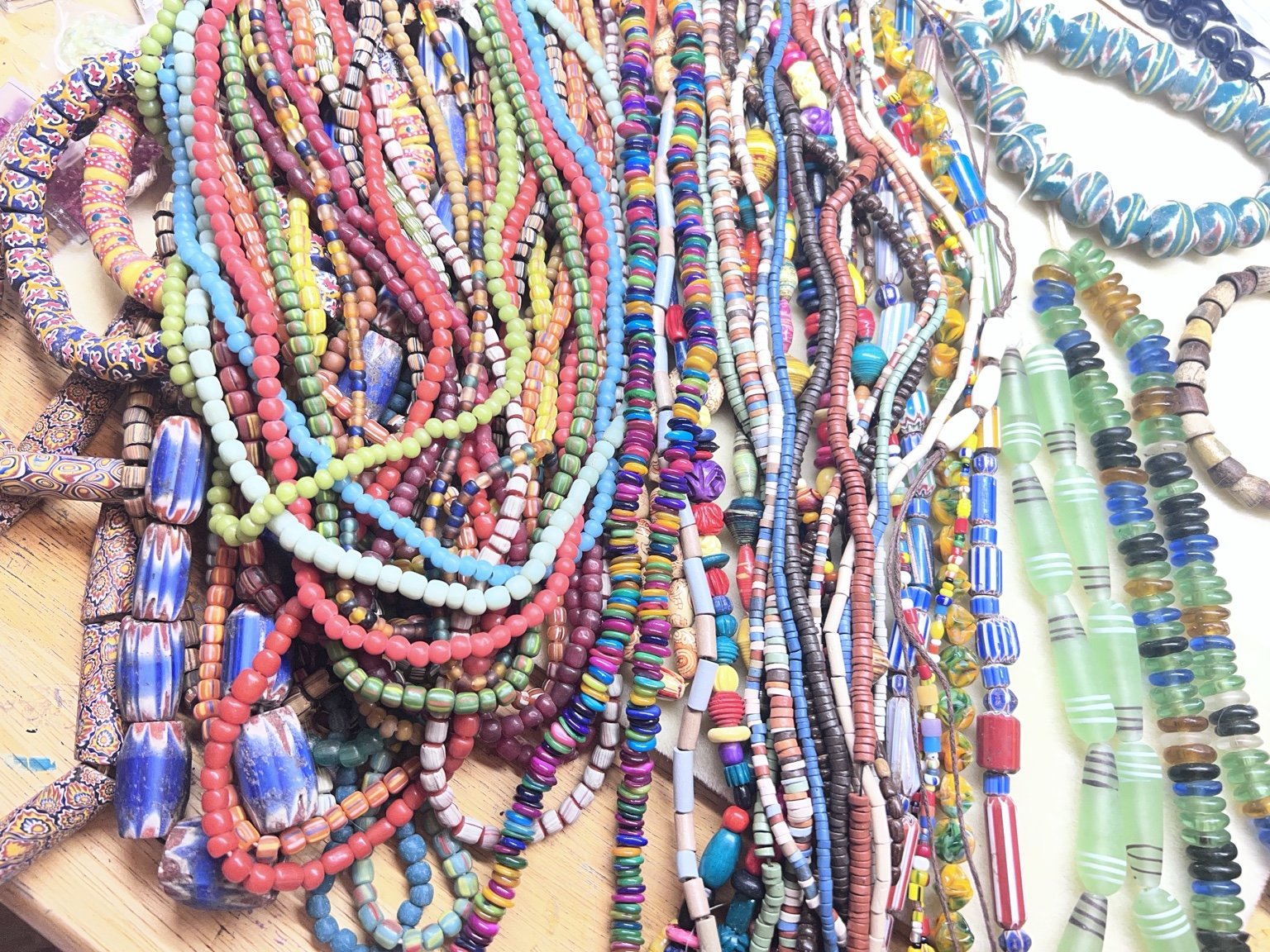
Looking at this gloriously tangled collection of beads on my table, I can't tell you the complete story of every one of them.
Some I know quite a bit about.
Some I know a little.
And some remain complete mysteries.
But perhaps that's part of their magic.
A bead can begin as sand, shell, stone, clay or glass.
It can pass through the hands of a maker.
Travel hundreds—or thousands—of miles.
Become meaningful to another person.
Be worn.
Traded.
Saved.
Collected.
Passed along.
And eventually land on another maker's bead mat, waiting to become part of something new.
Tiny objects. Enormous stories.
And this week, I think I'll spend a little more time listening to them. 🌍❤️
Until our threads cross again...
May your thread stay untangled, your needle easy to find, and your curiosity always lead you somewhere unexpected.
With gratitude,
Kristina & Kimberly
Sun & Thread Sisters
Nature Inspired • Heart Made • Sister Crafted.
🌿 A Little Further Down the Bead Trail
This Journal entry was inspired by the Rocky Mountain Bead Society Mini Challenge, my own bead collection, things I've learned along the way, and a little fresh research.
My interest became especially meaningful after hearing Melody MacDuffee speak about her experiences in Ghana and the work of Soul of Somanya.
If this story has made you curious too, museum collections are wonderful places to continue exploring, particularly the Smithsonian's National Museum of African Art and The Metropolitan Museum of Art.
And if you'd like to learn more about Melody MacDuffee and the artisans behind Soul of Somanya, you can visit Soul of Somanya.
Because apparently one bead rabbit hole is never quite enough. 😊
🌿 Behind the Beads: Lessons from Building Sun & Thread Sisters
🌿 Building a handmade business is about more than creating beautiful jewelry. It's about learning, adapting, making mistakes, and growing along the way. Here are a few lessons I've learned while building Sun & Thread Sisters—and why every setback has helped shape the journey.
By Kristina Amato
Sun & Thread Sisters
When I first started building Sun & Thread Sisters, I thought the hardest part would be making the jewelry.
It turns out...making the jewelry is the easy part. 😄
The real challenge has been learning everything that happens behind the scenes.
Over the past few months, I've discovered that running a handmade business means wearing a lot of different hats. Some fit comfortably...and some have taken a little adjusting. 😊
I've accidentally posted the wrong wording on a Reel.
I've had to rebuild my Facebook page after setting it up incorrectly.
I've learned that a single sentence can unintentionally change how people understand the story behind a piece.
I've spent hours learning websites, Pinterest, Instagram, SEO, photography, taxes, shipping, and more.
And yes...I've had a few moments where I simply thought,
"Well...that wasn't exactly how I planned that to go." 😂
The wonderful thing is that every one of those little headaches taught me something valuable.
I've learned that words matter.
I've learned that giving proper credit to the artists who inspire us matters.
I've learned that asking questions is far better than assuming I know the answer.
And I've learned that mistakes aren't failures—they're simply part of learning something new.
Every correction has made Sun & Thread Sisters a little stronger.
Every lesson has helped me become a better artist, teacher, storyteller, and business owner.
I'm still learning every single day...and honestly, I hope I always will.
Because if we're learning, we're growing.
If you're building something of your own—whether it's a business, a creative hobby, or simply trying something you've never done before—don't be discouraged by the mistakes.
They're not signs that you're failing.
They're signs that you're brave enough to keep going. 🌱
Looking back now, I wouldn't erase those little missteps.
They've become part of the story.
And every lesson has helped shape the heart of Sun & Thread Sisters into exactly what I hope it will become: a place built on creativity, integrity, kindness, and a lifelong love of learning.
Thank you for coming along on this journey with me. Your encouragement, thoughtful comments, and support mean more than you know. ❤️
Until our threads cross again...
May your thread stay untangled, your needle easy to find, and your creativity always lead you somewhere unexpected.
With gratitude,
Kristina & Kimberly
Sun & Thread Sisters
Nature Inspired • Heart Made • Sister Crafted.
Beading Is My Quiet Place
Finding Stillness One Stitch at a Time
By Kristina Amato
Sun & Thread Sisters
People often ask me what I think about while I'm beading.
The honest answer?
Almost everything.
Sometimes I'm thinking about my next design. Sometimes I'm remembering someone I love. Sometimes I'm working through a difficult decision. And sometimes...I'm not thinking much at all.
Especially when I'm doing bead embroidery.
There's something about placing one tiny bead after another that gently quiets the noise of everyday life. The world slows down. My breathing settles. The constant list of things I should be doing fades into the background, replaced by the simple rhythm of needle, thread, and bead.
I've come to realize that beading has become my form of meditation.
I didn't set out looking for meditation. I wasn't trying to escape life. I simply found that every time I sat down with a needle in my hand, something inside me became calmer.
As each stitch finds its place, my thoughts begin to untangle themselves.
Problems don't always disappear, but they often become clearer.
Worries lose some of their weight.
Ideas begin to bloom.
Sometimes the answers I've been searching for arrive quietly while I'm choosing the next bead.
For me, bead embroidery is especially peaceful.
Unlike many projects that require constant counting or checking a pattern, bead embroidery allows me to settle into a gentle rhythm. Every bead is added with intention, but there's also freedom. The design grows naturally, almost like watching a garden slowly come to life.
Hours can pass without me noticing.
It's one of the few places where my mind becomes completely present.
In today's world we're constantly surrounded by notifications, schedules, emails, and endless distractions. We rarely give ourselves permission to simply be still.
Beading offers that gift.
It reminds me that creativity doesn't have to be rushed.
Beautiful things are created one stitch at a time.
One bead at a time.
One quiet moment at a time.
I don't believe every beading session needs to produce a masterpiece.
Some of my favorite evenings end with only a few inches of progress.
But my heart feels lighter.
My mind feels clearer.
And somehow, the day feels complete.
If you've never tried approaching your beading as quiet time instead of productivity, I encourage you to give yourself permission.
Turn off your phone.
Play gentle music—or simply enjoy the silence.
Take a slow breath.
Don't worry about finishing the project.
Don't compare your work to anyone else's.
Just enjoy the simple act of creating.
Let the beads become your focus.
You may discover, as I have, that the greatest gift isn't the finished piece.
It's the peace you find while making it.
At Sun & Thread Sisters, we often say that every handmade piece carries a little bit of its maker's heart.
Perhaps that's because every stitch also carries a moment of stillness, hope, gratitude, or quiet reflection.
Maybe that's what people feel when they wear something handmade.
Not just the beauty of the beads...
...but the peace that was woven into every thread.
Until our threads cross again...
May your thread stay untangled, your needle easy to find, and your creativity always lead you somewhere unexpected.
With gratitude,
Kristina & Kimberly
Sun & Thread Sisters
Nature Inspired • Heart Made • Sister Crafted.
✨ A Little Studio Update from Sun & Thread Sisters ✨
One of the things I've learned over the past few weeks is that building a handmade business means wearing a lot of different hats.
Some days I'm designing jewelry.
Some days I'm writing tutorials.
Some days I'm photographing pieces, answering emails, or working on the website.
And lately... I've been completely immersed in something that's brought me so much joy—creating my little collection of beaded spiders and bringing each one to life with a name, a story, and a bit of Christmas magic.
These little spiders have been part of my creative life since 2022.
I began making them during a bout of COVID, when I was unable to get out and needed something joyful and imaginative to focus on. What started as a quiet creative escape slowly grew into something much more.
As I continued building the collection, I learned something I hadn't expected. Beaded spiders are part of a much larger creative tradition than I realized, with makers around the world creating their own beautiful versions.
Rather than discouraging me, that discovery reminded me why I started Sun & Thread Sisters in the first place. My goal has never been simply to make jewelry or ornaments—it has always been to tell stories, inspire creativity, and create a place where handmade art, learning, and imagination come together.
This year, I finally brought the collection fully to life—giving each spider a name, a title, a personality, and a story of her own. I also finished editing The Christmas Spider, the tale that inspired this growing little world.
Looking back, I realize the spiders were never just ornaments. They became a way to weave together beadwork, storytelling, tradition, and imagination—the very threads that lie at the heart of Sun & Thread Sisters.
Every spider has a personality.
Every piece has a story.
Every tutorial is created to help another maker discover something new.
Even though the studio has been wonderfully busy, I haven't forgotten about The Sun & Thread Journal.
If you have a few quiet moments this weekend, I'd love to invite you to catch up on everything that's been happening around the studio over the past month.
We've shared new Journal articles, introduced the beginning of The Bead Library, explored one of my favorite bead families, and continued adding new creations and stories to Sun & Thread Sisters.
Whether you're looking for inspiration, a little beading knowledge, or simply want to spend a few minutes with us in the studio, I hope you'll enjoy reading along.
🌿 Take a moment to explore the past month's Journal entries:
You'll find it here:
🌿https://sunandthreadsisters.com/journal
Thank you for following along on this creative adventure. Whether you've been here from the beginning or just recently discovered Sun & Thread Sisters, your encouragement, kind words, likes, comments, and shares truly mean more than you know.
Every bit of support helps this little dream continue to grow.
Until our threads cross again...
May your thread stay untangled, your needle easy to find, and your creativity always lead you somewhere unexpected.
With gratitude,
Kristina & Kimberly
Sun & Thread Sisters
Nature Inspired • Heart Made • Sister Crafted.
Turning Your SmartPhone Into a Jewelry Camera
Beautiful jewelry photography doesn’t require expensive equipment. Discover how natural light, patience, and a few simple tools helped us turn a smartphone into one of the most valuable tools in our studio.
Finding Beauty in Light, Detail, and the Handmade Process
This article contains affiliate links. As an Amazon Associate, Sun & Thread Sisters earns from qualifying purchases at no additional cost to you. We only recommend products we personally use, love, or believe would genuinely help fellow makers and artists.
When we first began photographing jewelry for Sun & Thread Sisters, we assumed beautiful product photography required expensive cameras, professional studios, and complicated lighting equipment.
What we discovered instead was something surprisingly encouraging:
Thoughtful light matters more than expensive gear.
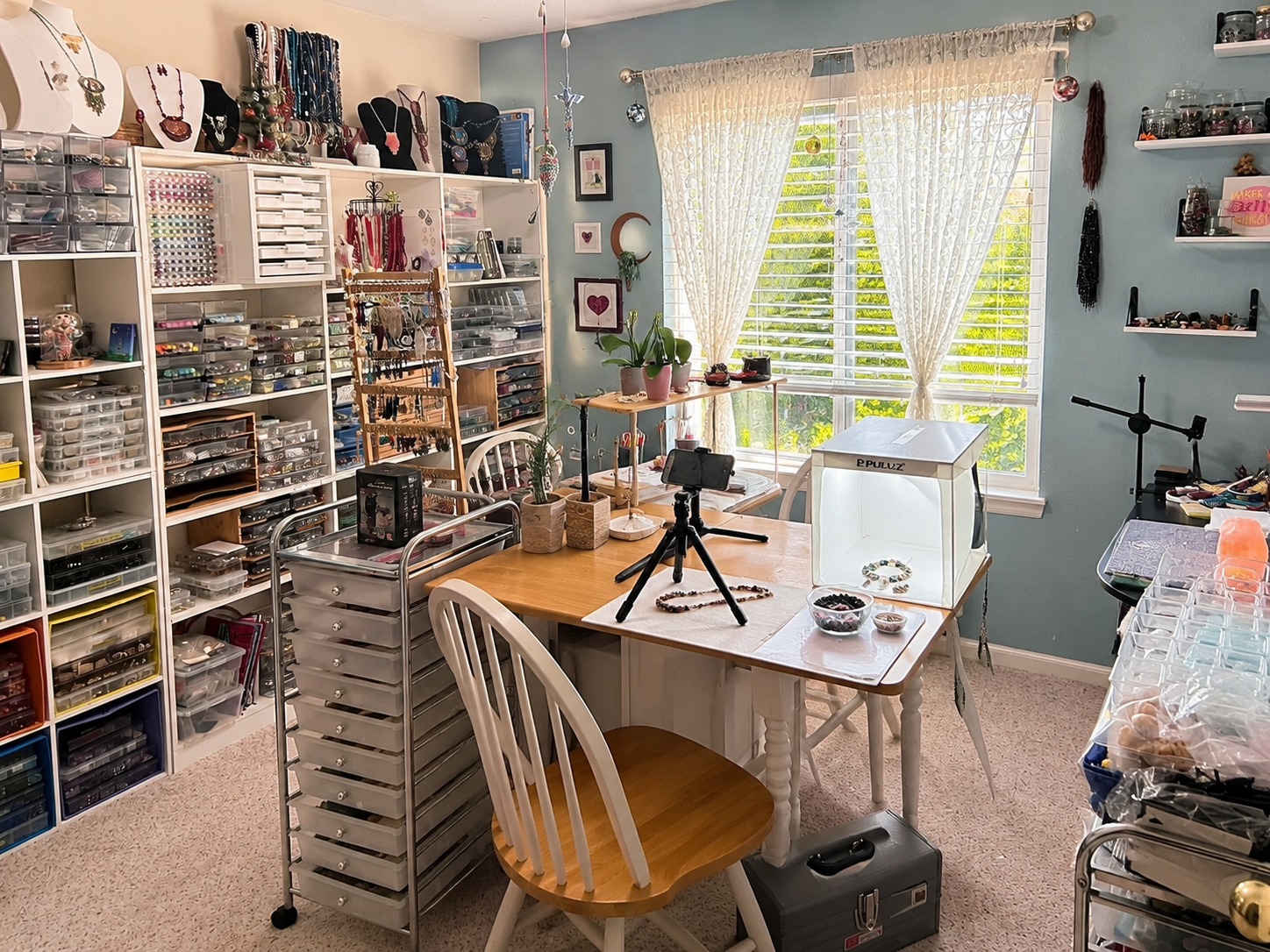
Many of our favorite photographs have been created with nothing more than a smartphone, a nearby window, and a few simple tools that help capture the sparkle, texture, and tiny details that make handmade beadwork so special.
Jewelry photography presents unique challenges. Metallic finishes reflect everything around them. Crystals catch light in unexpected ways. Tiny seed beads that look vibrant in person can suddenly appear flat or dull in a photograph.
Learning to photograph handmade jewelry has become its own creative skill — one that continues to evolve alongside our beadwork.
Today we'd like to share a few of the lessons we've learned while turning an everyday smartphone into one of the most valuable tools in our studio.
Find the Light Before You Find the Camera
The single biggest improvement we ever made to our jewelry photography had nothing to do with the camera itself.
It was the light.
Natural window light remains our favorite way to photograph beadwork because it reveals texture and color in a way that artificial lighting often struggles to reproduce.
A north-facing window provides soft, consistent light throughout much of the day, while east-facing windows often create beautiful morning illumination. Harsh midday sunlight can create bright reflections and strong shadows, so we usually prefer indirect light whenever possible.
Sometimes moving a piece just a few inches closer to the window can completely transform the photograph.
When photographing metallic finishes, crystals, or iridescent seed beads, patience often becomes more important than equipment. Rotating the jewelry slightly or waiting for the light to soften can reveal details that were invisible only moments before.
Light is not simply part of the photograph.
In many ways, light becomes part of the design itself.
Stability Creates Sharpness
Seed beads are small.
Very small.
The incredible detail that makes beadwork so beautiful also makes it surprisingly difficult to photograph. Even the slightest movement of the camera can soften edges, blur bead holes, or reduce the sparkle of crystals and metallic finishes.
For a long time, we simply held our phones and hoped for the best.
Eventually we discovered that stability creates clarity.
Whether using a tabletop tripod, resting the phone on a stable surface, or using a simple phone stand, reducing camera movement creates noticeably sharper images and allows the tiny details of handmade work to shine.
This becomes especially important when photographing:
Size 15/0 seed beads
Crystal accents
Delicate fringe
Metal findings and clasps
Textured bead surfaces
Sometimes the smallest improvements create the biggest differences.
One of the simplest improvements we made to our photography process was reducing camera movement. A stable phone allows tiny details like seed beads, crystals, and metal finishes to remain sharp and clear.
We especially appreciate a tripod that can function as both a tabletop stand and a portable photography tool for studio work, tutorials, and artisan events.
View our recommended tabletop phone tripod
The Magic Lives in the Details
One of the greatest joys of beadwork is found in the details.
The soft glow of matte finishes.
The sparkle of faceted crystals.
The subtle color shifts of metallic seed beads.
The way thread disappears into the structure of a design while quietly holding everything together.
These details are often what make someone stop scrolling and take a second look.
Close-up photography allows those details to tell the story of the piece.
A single image of a clasp, bead texture, or crystal reflection can sometimes communicate more craftsmanship than an image of the entire necklace or bracelet.
As artists, we spend countless hours making these details matter.
Photography gives them the opportunity to be seen.
Capturing those details can sometimes be difficult with a smartphone camera alone. A clip-on macro lens allows you to photograph bead textures, crystal sparkle, metallic finishes, and intricate thread paths with much greater clarity and detail.
We especially appreciate versatile lens kits that allow both close-up macro photography and wider shots for larger pieces such as necklaces and amulets.
View our recommended macro lens kit for smartphones
Editing Should Reveal, Not Redesign
This philosophy has become one of the guiding principles of photography at Sun & Thread Sisters.
Our goal is never to create a prettier version of the jewelry than what arrives in the mailbox.
Instead, our goal is to create photographs that represent the piece as honestly and beautifully as possible.
We may adjust exposure, brightness, white balance, contrast, and sharpness.
But we never alter bead placement, colors, gemstones, crystal finishes, thread paths, hardware, or handmade construction.
Every piece carries the fingerprints of the creative process.
Those details deserve to remain exactly as they were created.
Authenticity matters.
The jewelry in the photograph should always be the jewelry that arrives in your hands.
Creating a Studio That Works for You
One of the most encouraging discoveries in our photography journey has been learning that a professional studio isn't required to create beautiful images.
Some of our favorite tools are surprisingly simple:
A nearby window
White poster board for reflecting light
Neutral backgrounds
A steady surface for the camera
A little patience
A willingness to experiment
Every artist eventually develops their own photography style just as they develop their own artistic voice.
Some prefer dramatic shadows.
Some prefer bright, airy images.
Some photograph outdoors while others create miniature studios inside their homes.
There is no single correct approach.
The best setup is often the one that encourages you to continue creating.
Natural window light remains our favorite photography tool, but cloudy days, winter evenings, and late-night creative sessions do not always cooperate.
A portable light box can provide soft, even lighting and consistent backgrounds, making it easier to photograph jewelry regardless of the season or time of day.
View our recommended photography light box
The Camera You Already Own May Be Enough
One of the most valuable lessons we've learned is that beautiful photography rarely begins with expensive equipment.
It begins with observation.
It begins with learning how light moves across a piece of jewelry.
It begins with noticing how crystals catch the morning sun or how metallic seed beads shift colors throughout the day.
Most of all, it begins with practice.
Photography, much like beadwork itself, improves one project at a time.
If you're a fellow artist, maker, or creative business owner, we hope these ideas encourage you to experiment, play, and share your work with confidence.
The world deserves to see what you're creating.
Sometimes all it takes is the camera already sitting in your pocket.
Final Thoughts
The best camera is rarely the most expensive one.
More often, it's the one that's already nearby when inspiration strikes.
At Sun & Thread Sisters, we've learned that photography and beadwork share something important in common: both reward patience, both improve with practice, and both invite us to slow down long enough to notice the details that make something truly special.
If you're a fellow maker, artist, or small business owner, we hope these ideas encourage you to pick up the camera you already own and begin sharing your creative journey with confidence.
Sometimes all it takes is a little light, a little curiosity, and the camera already sitting in your pocket.
Until our threads cross again...
May your thread stay untangled, your needle easy to find, and your creativity always lead you somewhere unexpected.
With gratitude,
Kristina & Kimberly
Sun & Thread Sisters
Nature Inspired • Heart Made • Sister Crafted.
Why Seed Bead Size Matters: Understanding 15/0, 11/0, 8/0 & More
Understanding seed bead sizes is one of the foundations of beautiful beadwork. Discover when to use 15/0, 11/0, 8/0, and 6/0 seed beads, compare their sizes, and gain confidence choosing the right beads for your next jewelry project.
Not all seed beads are created equal. Whether you’re new to bead weaving or expanding your skills, understanding seed bead sizes will help you choose the right materials, follow patterns with confidence, and bring your creative ideas to life. From handcrafted jewelry and wearable art to bead embroidery, ornaments, decorative art, mixed-media projects, and countless other beaded creations, choosing the right seed bead size is one of the beast foundations you can build.
Tiny Beads, Big Difference
One of the first things many new beaders notice is that seed beads come in a surprising variety of sizes. At first glance, they may all look similar, but once you begin creating jewelry, you'll quickly discover that bead size has a tremendous impact on the finished project.
The size of your seed beads influences everything—from the texture and flexibility of your design to the level of detail you can achieve. Choosing the right size can make a project easier to stitch, more durable, more visually balanced, and - when creating wearable pieces - more comfortable to wear.
Whether you're picking up a needle for the first time or adding another technique to your growing collection of skills, understanding seed bead sizes is one of the best foundations you can build.
What Do the Numbers Mean?
If you've ever wondered why seed beads are labeled 15/0, 11/0, 8/0, or 6/0, you're not alone. At first, the numbering system seems backwards.
The "/0" (pronounced aught) comes from an old sizing system. Originally, it referred to how many beads could fit side-by-side within a given length. The greater the number of beads that fit into that space, the smaller each individual bead had to be.
So, a 15/0 bead is smaller than an 11/0, while an 8/0 and 6/0 become progressively larger.
A Quick Reference Guide
The chart below highlights the four seed bead sizes you’ll encounter most often. Historically, seed beads have been produced in sizes ranging from approximately 24/0 to 1/0, although availability varies by manufacturer, country of origin, and time period. Because there is no single worldwide sizing standard, you may occasionally find slight difference between brands.
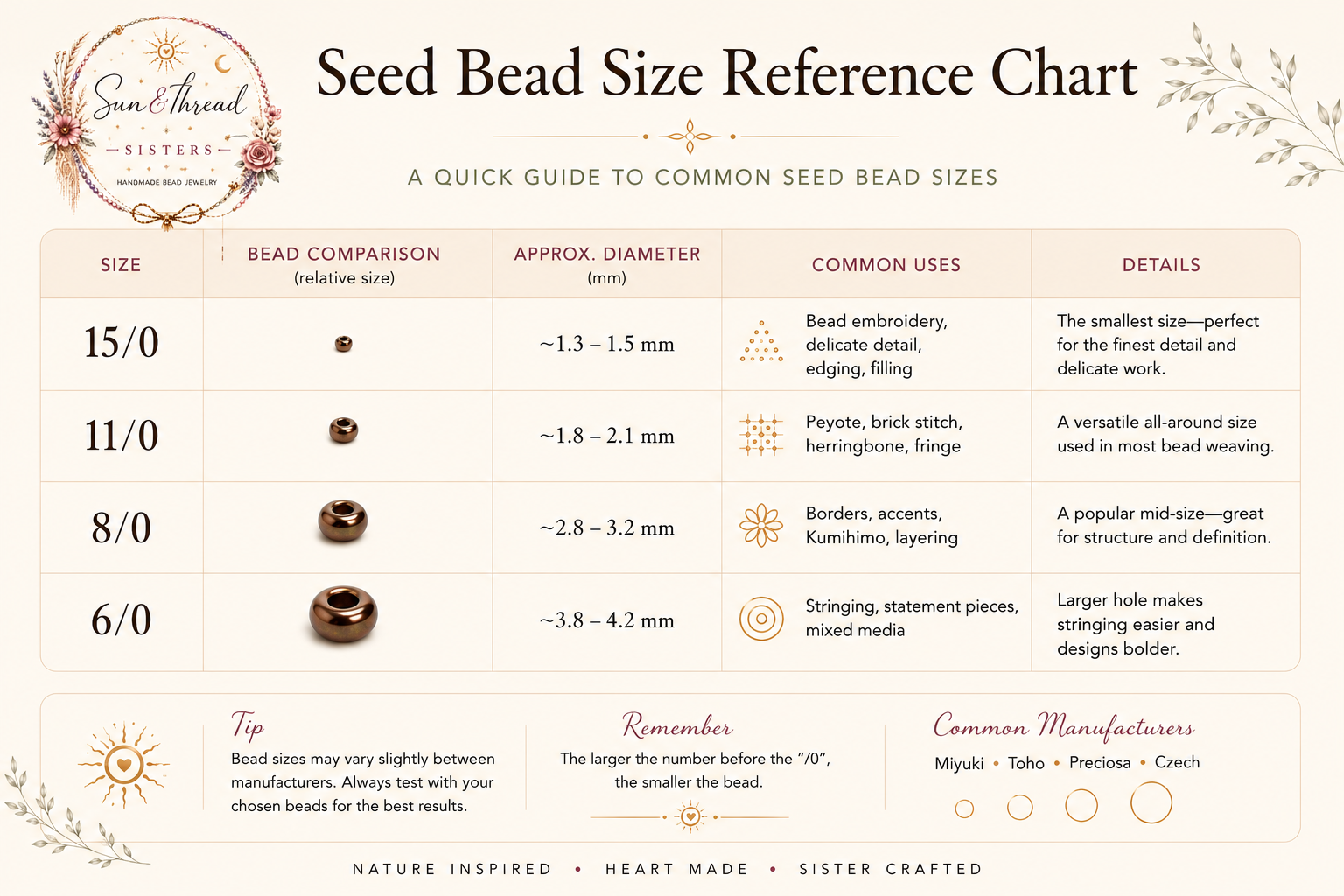
Sun & Thread Sisters seed bead size reference chart comparing 15/0, 11/0, 8/0, and 6/0 seed bead sizes with common uses and approximate diameters.
Although the historical sizing system isn't perfectly standardized today, these size numbers remain the universal language of seed beads used by bead artists around the world.
Did you know? Many bead artists begin with 11/0 seed beads because they’re the most versatile size available. As your skills grow, you’ll naturally add 15/0 beads for delicate work and 8/0 or 6/0 beads for texture and larger designs.
Getting to know the Most Common Seed Bead Sizes
15/0 Seed Beads
Tiny and delicate, 15/0 seed beads are perfect for adding fine detail. They're often used to create smooth bezels around cabochons, finish edges, fill small gaps, and add texture to bead embroidery or intricate bead weaving.
Because they are so small, they require patience, good lighting, and a steady hand. The reward is beautifully refined work with crisp, elegant details.
At Sun & Thread Sisters, I often use 15/0 seed beads when a design calls for precision or delicate finishing touches. Although they require a little more patience, these tiny beads can transform a good design into one with exceptional detail and refinement. In my Half Tila Basket Weave Bracelet Tutorial, I recommend Miyuki or Toho 15/0 seed beads for their consistency, beautiful finishes, and dependable quality.
11/0 Seed Beads
If there is one size that belongs in every bead artist's studio, it's the 11/0.
Often called the workhorse of bead weaving, 11/0 seed beads are one of the most versatile beads available. You'll find 11/0 seed beads used in countless techniques, including peyote stitch, brick stitch, herringbone, netting, right-angle weave, ladder stitch, and many more.
Both Miyuki and Toho manufacture excellent 11/0 seed beads, each offering outstanding quality and consistency that bead artists around the world have come to trust
8/0 Seed Beads
Larger than 11/0s, 8/0 seed beads create bold texture while remaining comfortable to work with, making them an excellent choice for beginners.
They're commonly used for decorative borders, stringing projects, Kumihimo, and designs where the beads themselves become part of the visual statement. Their larger holes also make multiple thread passes easier, making them especially forgiving for beginners and techniques that require reinforcing stitches.
6/0 Seed Beads
The largest of the commonly used seed bead sizes, 6/0 beads make a dramatic impression. They work beautifully in necklaces, bracelets, ornaments, mixed-media art, and decorative embellishments. They’re popular in fiber arts, ornaments, decorative home accents, and larger sculptural beadwork where bold texture becomes part of the design.
Combined with smaller seed beads, they add depth, texture, and visual contrast to a design.
As you continue exploring bead weaving, you’ll naturally discover that no single bead size is “better” than another. Each size serves a different purpose, and many of the most beautiful projects combine several sizes to create depth, texture, movement, and visual internest. Learning when to use each size is a part of the joy of growing as a bead artist.
Size Affects More Than Appearance
Choosing the right seed bead size isn't simply about making something bigger or smaller.
Smaller beads allow you to create delicate curves, intricate patterns, and refined finishes. Larger beads produce bold lines, stronger texture, and projects that often work up more quickly.
The same pattern stitched with 15/0 seed beads can look elegant and highly detailed, while the same design created with 8/0 beads may feel rustic, playful, or contemporary.
Understanding these differences gives you more creative freedom as an artist.
Why Consistency Matters
Not all seed beads are manufactured with the same precision.
Japanese manufacturers such as Miyuki and Toho are known throughout the beading community for producing remarkably consistent seed beads. Their precision makes them favorites among bead weavers, especially for techniques like peyote stitch, brick stitch, herringbone, and tapestry work where even tiny variations can affect the finished design.
Uniform bead sizes allow stitches to line up neatly, thread paths to remain even, and finished jewelry to drape beautifully.
Choosing high-quality beads often makes both the stitching experience and the finished piece noticeably better.
Personally, my favorite beads for precision bead weaving are Toho Aikos. Their exceptional consistency makes them my first choice for peyote stitch, brick stitch, loom weaving, and other techniques where perfectly uniform beads produce the cleanest results.
Building Your Collection
When you're just beginning your beading journey, it's easy to feel overwhelmed by the seemingly endless variety of colors, finishes, and sizes available.
The good news is—you don't need them all.
A small collection of quality 11/0 seed beads in several neutral colors will carry you through countless projects. As your skills grow, you can gradually add 15/0 seed beads for fine detail and 8/0 or 6/0 seed beads for bold texture and larger designs.
Building your collection slowly allows you to discover the colors, finishes, and styles that inspire you most.
My Favorite Starting Collection
If I were helping a new bead artist build their very first seed bead collection, I'd begin with quality 11/0 Miyuki seed beads in a few versatile colors such as silver-lined crystal, matte black, ivory, bronze, and gold.
From there, I'd add a handful of favorite colors that make you smile. As your confidence grows, begin adding 15/0 beads for fine detail and 8/0 beads for texture and accents.
There's no need to buy hundreds of colors all at once. A thoughtfully chosen collection will inspire far more creativity than an overflowing drawer of beads you've never used. Looking back, I wish I had started with quality beads from the very beginning rather than buying every color at a big box store, when they went on sale. I also learned to buy only for each project and what is needed to create it. Investing in quality beads and components has. helped me create better projects and enjoy the process even more.. As you collection grows, let your curiosity guide you. Every new color, finish, and bead size becomes another opportunity to experiment, learn, and develop your own creative style.
Every Bead Has a Purpose
One of the things I love most about bead weaving is that every tiny bead contributes to the final design. Individually they may seem insignificant, but together they create beautiful works of art filled with color, texture, and craftsmanship.
Understanding seed bead sizes isn't about memorizing numbers—it's about learning the language of beadwork and discovering how each size contributes to the finished design.
The more familiar you become with these sizes, the more confidently you'll choose materials, follow patterns, and create designs that reflect your own artistic vision.
Whether you're stitching your very first bracelet or your hundredth, every bead is another opportunity to learn, create, and enjoy the process.
Happy beading!
Kristina Amato
Sun & Thread Sisters
If you enjoyed this article, you may also like:
Meet the Tila Family: Understanding Tila, Half Tila & Quarter Tila Beads
Join us every Tuesday for a new Journal Entry filled with tips, tutorials, and inspiration. Is there a beading topic you’d like us to cover? We’d love to hear from you! Send us your ideas, and they may inspire a future Sun & Thread Sisters Journal Entry.
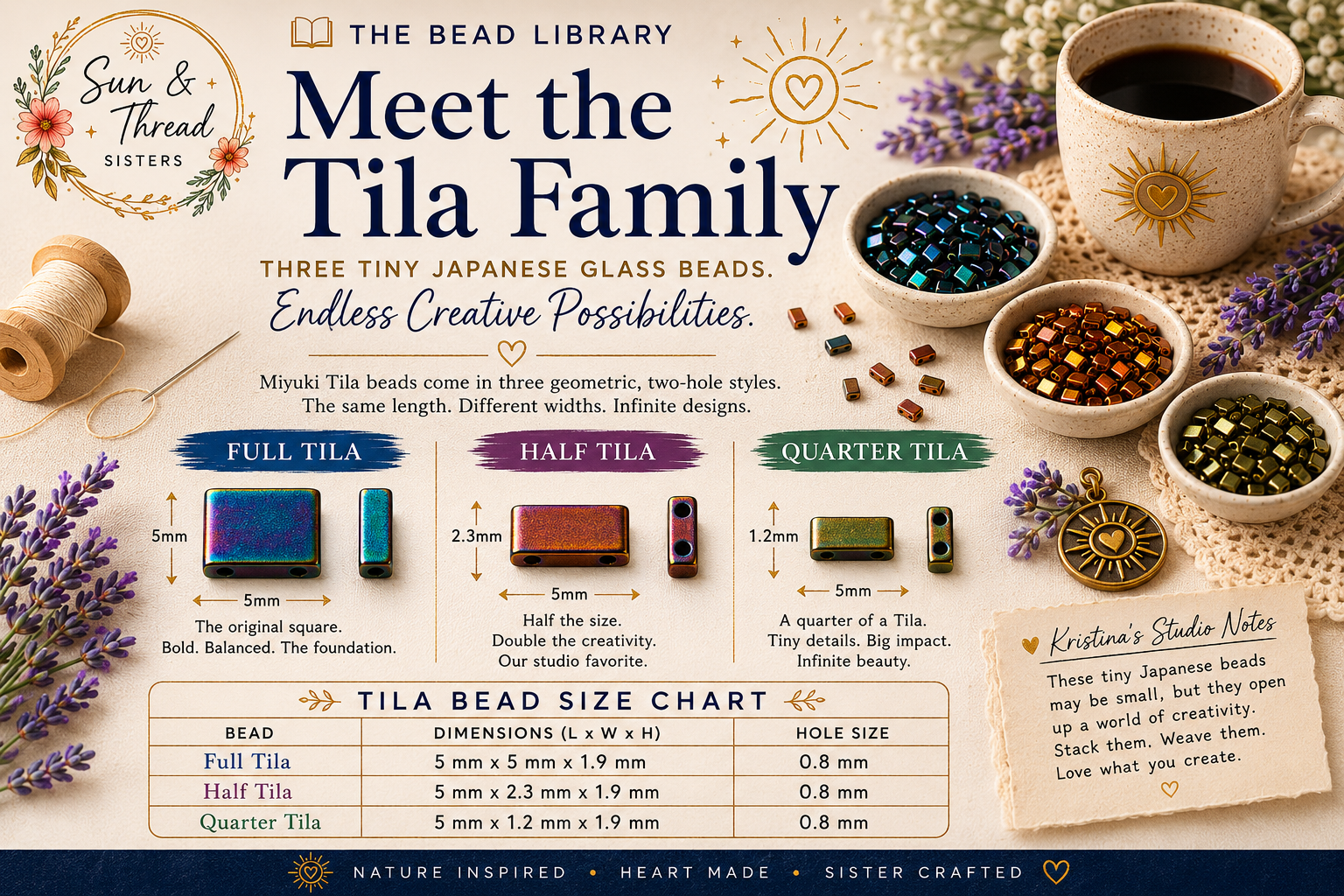
A story about Tila Beads
Pull up a chair and join us as we explore the remarkable Miyuki Tila bead family. From their fascinating history to their endless creative possibilities, discover why these tiny Japenese glass beads continue to inspire our jewelry and tutorials.
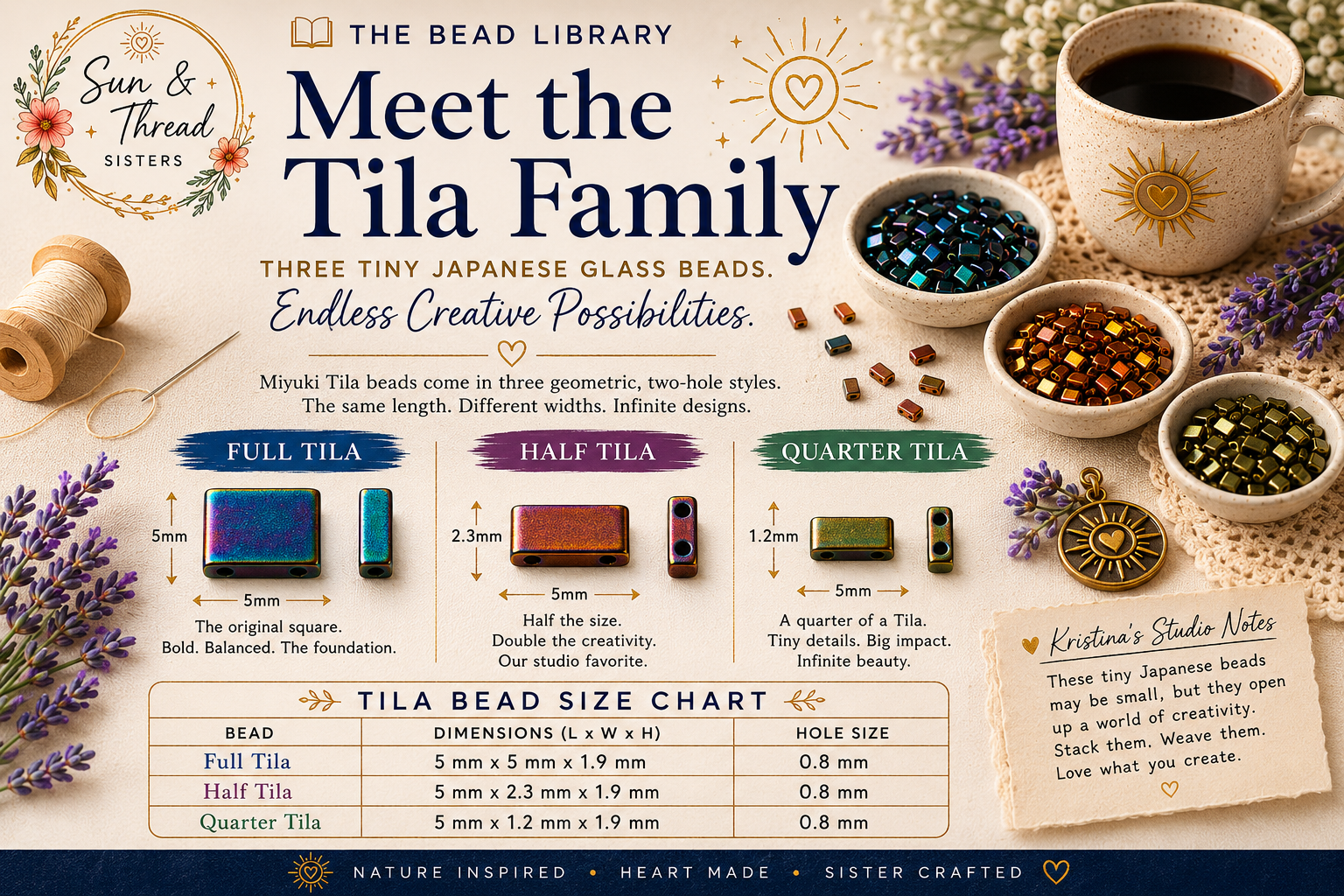
The Bead Library will be a continuing series exploring the history, beauty, and creative possibilities of the beads that inspire us.
"Pull up a chair, pour yourself a cup of coffee, and let's spend a little time talking about one of my favorite bead families."
There are some beads that quietly become part of your collection, and then there are beads that completely change the way you think about bead weaving.
For me, that bead was the Tila.
I still remember opening my very first package and pouring those tiny glass beads onto my bead mat. Instead of rolling around like traditional seed beads, they settled into neat little rows like miniature mosaic tiles, each one perfectly shaped and waiting to become something beautiful.
At first glance, they seemed wonderfully simple.
Flat.
Geometric.
Perfectly precise.
But as I picked one up and turned it over in my hand, I realized these weren't simply another bead—they were a completely different way of thinking about design.
The shape itself became part of the pattern.
That simple discovery opened an entirely new world of creativity, and ever since then, the Tila family has remained one of my favorite bead collections to work with.
Today I'd love to introduce you to these remarkable little beads and explain why they've become favorites of bead artists around the world.
A Little History
Every beautiful bead has a story.
The story of the Tila family begins in Hiroshima, Japan, where Miyuki has spent more than seventy-five years perfecting the art of manufacturing precision glass seed beads.
Founded in 1949, Miyuki earned a worldwide reputation for producing beads with extraordinary consistency. Every bead is carefully manufactured so artists can create smooth, balanced beadwork with remarkable precision.
In 2011, Miyuki introduced something completely new.
The original Tila bead.
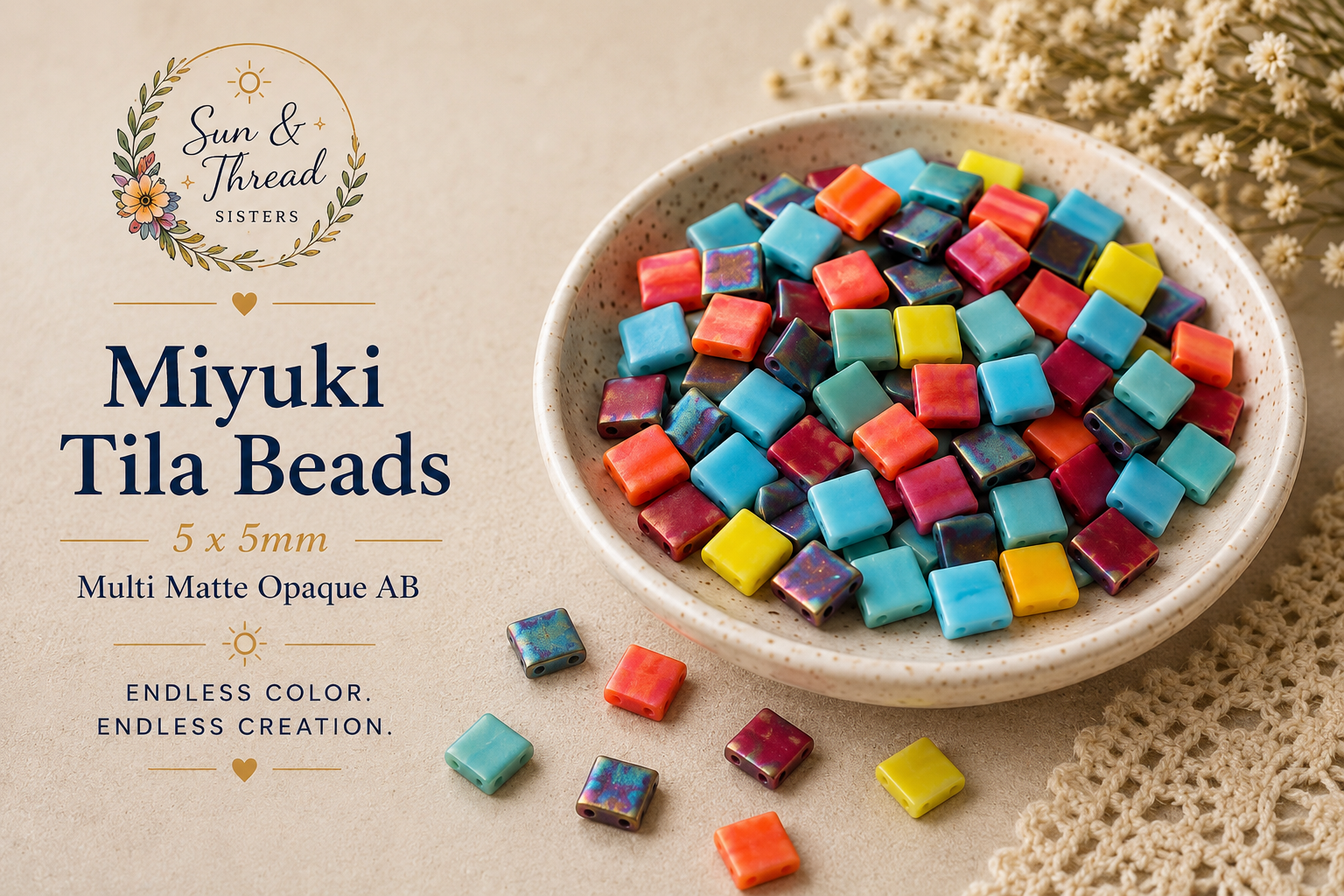
Unlike traditional round seed beads, the Tila was designed as a flat square with two perfectly aligned holes. Inspired by the appearance of ceramic tiles, these innovative beads could be woven together into jewelry that looked more like fabric or mosaic art than traditional beadwork.
Designers immediately recognized the possibilities.
As artists experimented with the original Tila, they wanted even greater flexibility.
In 2016, Miyuki introduced the Half Tila.
By keeping the same five-millimeter length while reducing the width to just 2.3 millimeters, bead artists suddenly gained the ability to create flowing curves, intricate textures, increases, decreases, and beautifully woven designs.
Then, in 2017, the family was completed with the Quarter Tila.
At only 1.2 millimeters wide, this tiny bead added incredible detail and precision, making it perfect for borders, accents, and intricate finishing work.
Together, these three beads transformed modern bead weaving and continue to inspire artists across the world.
Meet the Family
■ Full Tila
The original Tila measures 5 × 5 mm, creating a perfectly square, two-hole bead.
Its bold shape creates clean geometric lines and striking architectural designs.
I love using Full Tilas when I want a piece to feel balanced, structured, and contemporary.
They're ideal for:
• Statement bracelets
• Modern cuffs
• Mosaic-inspired jewelry
• Bold geometric designs
Think of the Full Tila as the foundation of the family—strong, confident, and beautifully balanced.
▭ Half Tila
If I had to choose my favorite member of the family, the Half Tila would probably win.
Measuring 5 × 2.3 mm, it keeps the same length as the original while becoming wonderfully flexible.
That simple change opens countless creative possibilities.
Half Tilas create movement.
Texture.
Soft curves.
Elegant woven surfaces that almost resemble fabric.
They're perfect for:
• Basket weave
• Herringbone-inspired designs
• Brick stitch combinations
• Layered textures
• Elegant bracelets and necklaces
Half Tilas are also the bead that inspired my own Half Tila Basket Weave Bracelet Tutorial. I love the way these tiny rectangles fit together like pieces of a mosaic, creating beautiful texture that changes with every color combination.
No matter how many times I use them, they continue to surprise me.
▪ Quarter Tila
The smallest member of the family measures just 5 × 1.2 mm, but don't let its size fool you.
Quarter Tilas are tiny details that often make the biggest difference.
They're wonderful for:
• Delicate borders
• Intricate accents
• Elegant spacers
• Fine detail work
• Combining beautifully with both Full and Half Tilas
Sometimes the smallest bead quietly brings an entire design together.
One Family. Three Shapes.
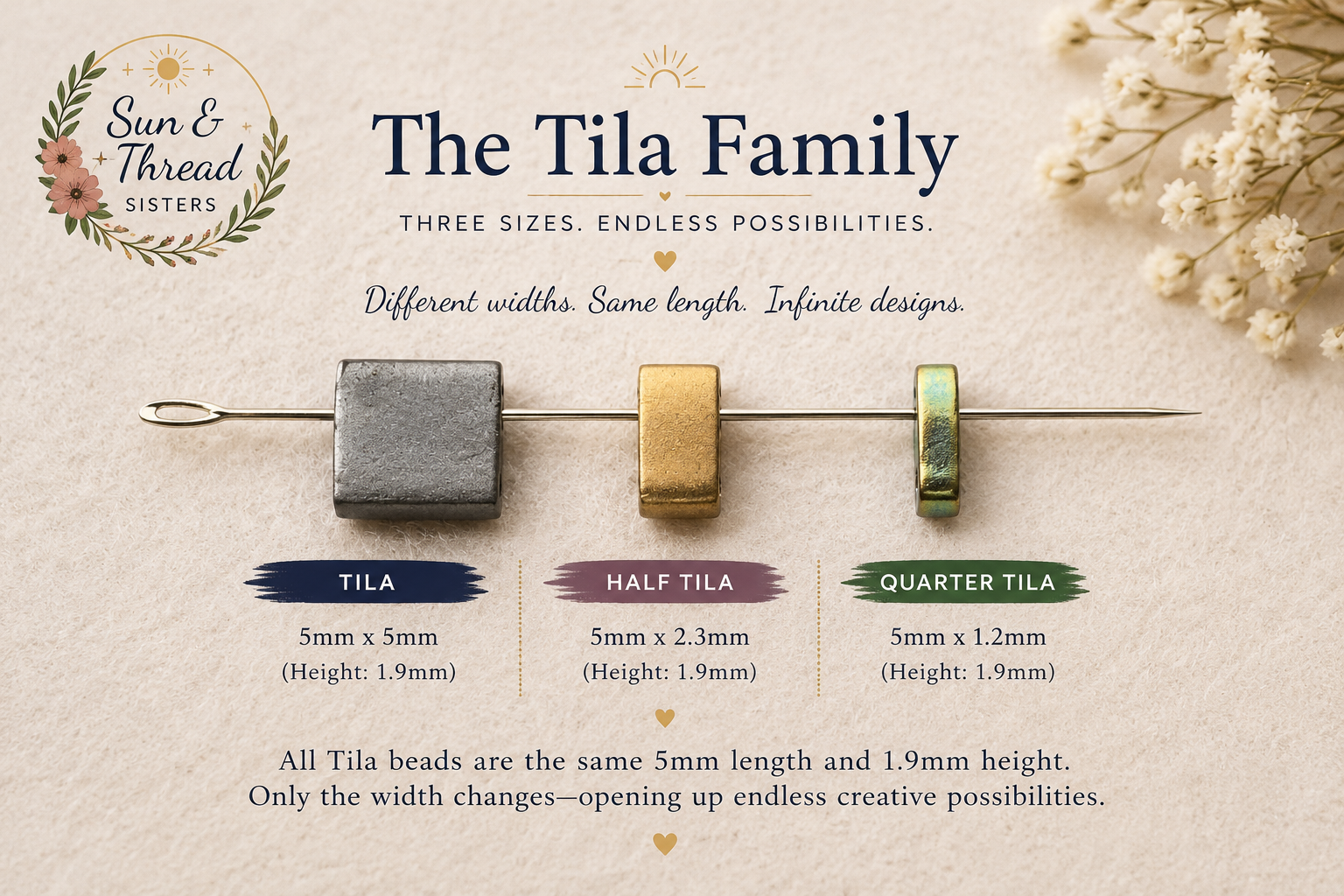
One of my favorite things about the Tila family is how thoughtfully they're designed.
Every bead shares the same:
• 5 mm length
• 1.9 mm thickness
• 0.8 mm hole size
Only the width changes.
BeadDimensionsFull Tila5 × 5 × 1.9 mmHalf Tila5 × 2.3 × 1.9 mmQuarter Tila5 × 1.2 × 1.9 mm
Because they're designed to work together, artists can easily mix all three sizes within the same project to create depth, movement, and beautiful architectural patterns.
Why I Love the Tila Family
One of the things I love most about these beads is that each size has its own personality.
The Full Tila makes a statement.
The Half Tila creates movement.
The Quarter Tila quietly fills the spaces that make a design feel complete.
Together, they remind me that beautiful beadwork isn't about using the biggest bead or the most expensive bead.
It's about understanding how each tiny piece contributes to something much greater.
As bead artists, we spend countless hours choosing colors, finishes, textures, and materials.
The Tila family reminds us that shape can be just as inspiring.
From Our Studio
One of the greatest joys of bead weaving is that every project begins with possibility.
Sometimes that possibility starts with a sketch.
Sometimes it starts with a color palette inspired by nature.
And sometimes...
It begins with a handful of beads scattered across a bead mat and a simple question.
"What happens if I try this?"
Those moments of curiosity have led to some of my favorite designs.
They're also the reason I continue learning, experimenting, and teaching.
Every finished bracelet, necklace, or piece of wearable art began as an idea waiting to be explored.
That's one of the reasons I love teaching.
Watching someone discover a new bead for the first time reminds me of why I fell in love with bead weaving in the first place.
☕ Coffee at the Worktable
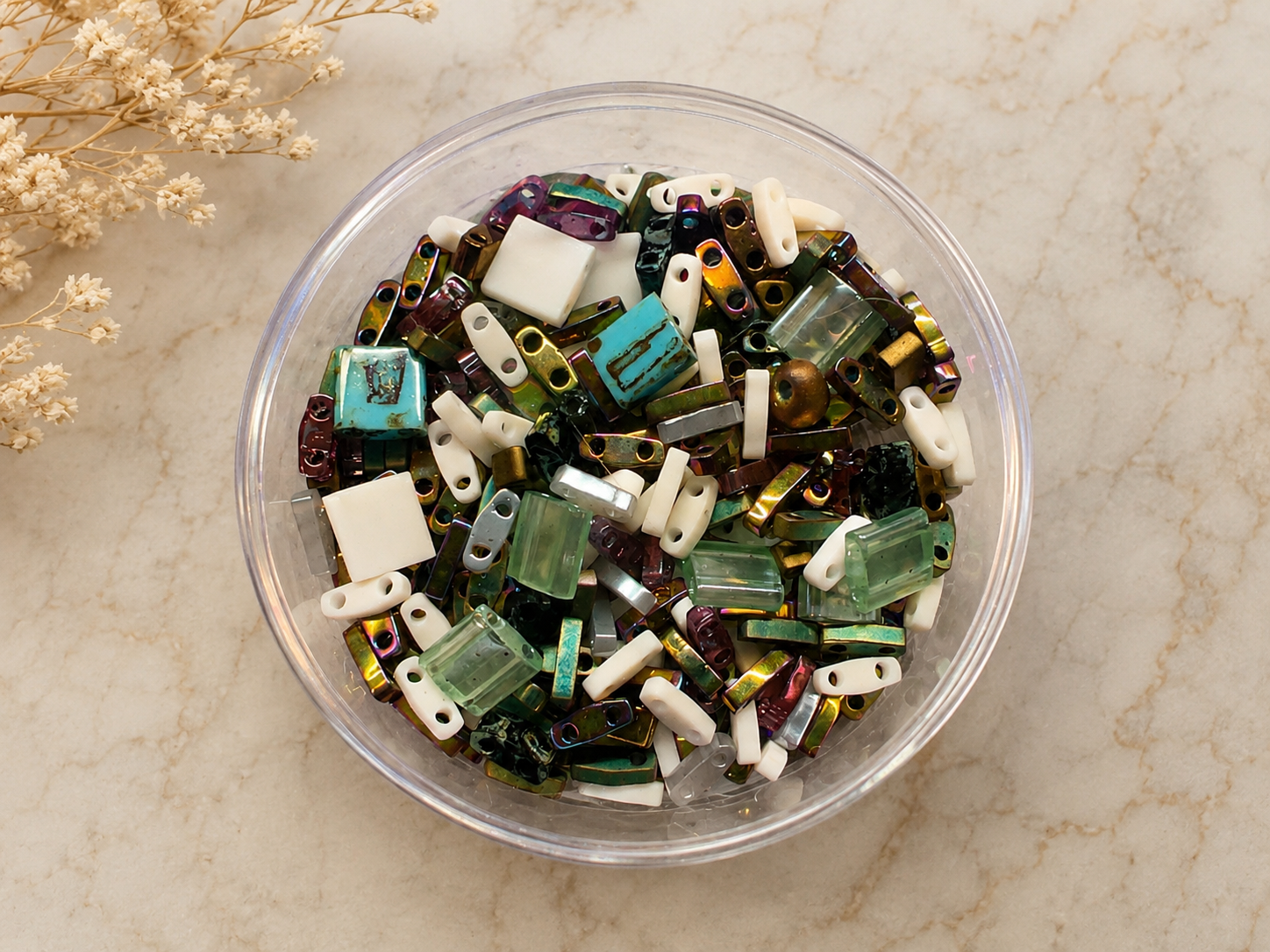
If you're just beginning your journey with Tila beads, don't feel like you need every color or finish before you start.
Choose a few that make you smile.
Spread them across your worktable.
Pick them up.
Turn them over in the light.
See how beautifully they fit together.
Some of my favorite designs have started with nothing more than a handful of Half Tilas, a needle, a spool of thread, a cup of coffee, and one simple thought:
"I wonder what would happen if I tried this?"
That's the magic of bead weaving.
The beads may stay the same...
But the possibilities never do.
Until Our Threads Cross Again...
Thank you for spending a little time with us in the studio today.
Whether you've been bead weaving for decades or you've just discovered the Tila family, we hope today's story inspired you to slow down, explore something new, and discover the beauty hidden in even the smallest details.
Our hope for The Sun & Thread Journal is simple—to create a place where artists, collectors, students, and curious makers can gather to learn, be inspired, and celebrate the remarkable world of beadwork together.
May your thread stay untangled, your needle easy to find, and your creativity always lead you somewhere unexpected.
With gratitude,
Kristina & Kimberly
Sun & Thread Sisters
Nature Inspired. Heart Made. Sister Crafted.
Welcome to Sun & Thread Sisters
Welcome to Sun & Thread Sisters, where creativity, craftsmanship, and nature-inspired design come together. Join us as we share our handmade jewelry, tutorials, workshops and the stories behind the art we create.
Hello and welcome!
We are Kristina and Kimberly, the sisters behind Sun & Thread Sisters.
What began as a shared love of creativity has grown into a journey of handmade jewelry, beadwork, wearable art, tutorials, workshops, and a deep appreciation for the beauty found in nature.
Every piece we create is handcrafted with care. We work with seed beads, gemstones, crystals, pearls, vintage treasures, and unique materials gathered over years of collecting and learning. Some designs are inspired by the colors of the forest, the movement of water, wildflowers, sunsets, and the simple beauty found in everyday moments.
At Sun & Thread Sisters, we believe handmade art tells a story. Each bracelet, necklace, earring, and beaded creation carries the time, patience, and creativity of the artist who made it.
This blog will be a place where we share:
• Behind-the-scenes looks into our studio
• New jewelry and artwork releases
• Beading tips and techniques
• Tutorials and workshop announcements
• Inspiration from nature and everyday life
• Stories behind our favorite creations
Whether you're a jewelry lover, a fellow artist, an experienced beadworker, or someone who is just discovering the joy of handmade art, we're delighted you're here.
Thank you for supporting small artists, handmade craftsmanship, and creative dreams.
We invite you to follow along as we continue creating, learning, and sharing our journey.
Until Our Threads Cross Again...
Thank you for spending a little time with us in the studio today.
We hope today's story inspired you to look a little closer, create a little more boldly, and discover the beauty hidden in even the smallest details.
May your thread stay untangled, your needle easy to find, and your creativity always lead you somewhere unexpected.
With gratitude,
Kristina & Kimberly
Sun & Thread Sisters
Nature Inspired. Heart Made. Sister Crafted.