

A story about Tila Beads
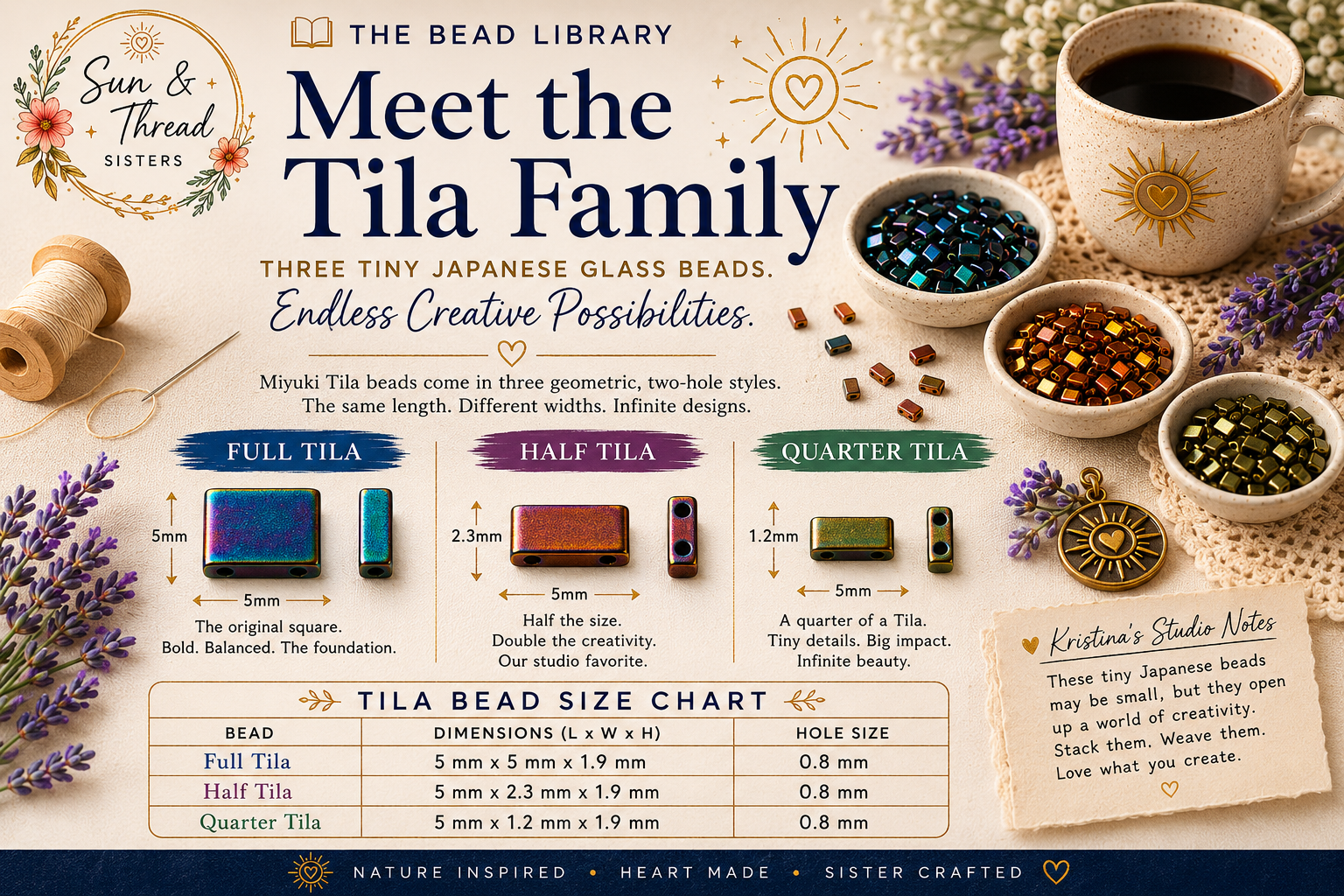
The Bead Library will be a continuing series exploring the history, beauty, and creative possibilities of the beads that inspire us.
"Pull up a chair, pour yourself a cup of coffee, and let's spend a little time talking about one of my favorite bead families."
There are some beads that quietly become part of your collection, and then there are beads that completely change the way you think about bead weaving.
For me, that bead was the Tila.
I still remember opening my very first package and pouring those tiny glass beads onto my bead mat. Instead of rolling around like traditional seed beads, they settled into neat little rows like miniature mosaic tiles, each one perfectly shaped and waiting to become something beautiful.
At first glance, they seemed wonderfully simple.
Flat.
Geometric.
Perfectly precise.
But as I picked one up and turned it over in my hand, I realized these weren't simply another bead—they were a completely different way of thinking about design.
The shape itself became part of the pattern.
That simple discovery opened an entirely new world of creativity, and ever since then, the Tila family has remained one of my favorite bead collections to work with.
Today I'd love to introduce you to these remarkable little beads and explain why they've become favorites of bead artists around the world.
A Little History
Every beautiful bead has a story.
The story of the Tila family begins in Hiroshima, Japan, where Miyuki has spent more than seventy-five years perfecting the art of manufacturing precision glass seed beads.
Founded in 1949, Miyuki earned a worldwide reputation for producing beads with extraordinary consistency. Every bead is carefully manufactured so artists can create smooth, balanced beadwork with remarkable precision.
In 2011, Miyuki introduced something completely new.
The original Tila bead.
Unlike traditional round seed beads, the Tila was designed as a flat square with two perfectly aligned holes. Inspired by the appearance of ceramic tiles, these innovative beads could be woven together into jewelry that looked more like fabric or mosaic art than traditional beadwork.
Designers immediately recognized the possibilities.
As artists experimented with the original Tila, they wanted even greater flexibility.
In 2016, Miyuki introduced the Half Tila.
By keeping the same five-millimeter length while reducing the width to just 2.3 millimeters, bead artists suddenly gained the ability to create flowing curves, intricate textures, increases, decreases, and beautifully woven designs.
Then, in 2017, the family was completed with the Quarter Tila.
At only 1.2 millimeters wide, this tiny bead added incredible detail and precision, making it perfect for borders, accents, and intricate finishing work.
Together, these three beads transformed modern bead weaving and continue to inspire artists across the world.
Meet the Family
■ Full Tila
The original Tila measures 5 × 5 mm, creating a perfectly square, two-hole bead.
Its bold shape creates clean geometric lines and striking architectural designs.
I love using Full Tilas when I want a piece to feel balanced, structured, and contemporary.
They're ideal for:
• Statement bracelets
• Modern cuffs
• Mosaic-inspired jewelry
• Bold geometric designs
Think of the Full Tila as the foundation of the family—strong, confident, and beautifully balanced.
▭ Half Tila
If I had to choose my favorite member of the family, the Half Tila would probably win.
Measuring 5 × 2.3 mm, it keeps the same length as the original while becoming wonderfully flexible.
That simple change opens countless creative possibilities.
Half Tilas create movement.
Texture.
Soft curves.
Elegant woven surfaces that almost resemble fabric.
They're perfect for:
• Basket weave
• Herringbone-inspired designs
• Brick stitch combinations
• Layered textures
• Elegant bracelets and necklaces
Half Tilas are also the bead that inspired my own Half Tila Basket Weave Bracelet Tutorial. I love the way these tiny rectangles fit together like pieces of a mosaic, creating beautiful texture that changes with every color combination.
No matter how many times I use them, they continue to surprise me.
▪ Quarter Tila
The smallest member of the family measures just 5 × 1.2 mm, but don't let its size fool you.
Quarter Tilas are tiny details that often make the biggest difference.
They're wonderful for:
• Delicate borders
• Intricate accents
• Elegant spacers
• Fine detail work
• Combining beautifully with both Full and Half Tilas
Sometimes the smallest bead quietly brings an entire design together.
One Family. Three Shapes.
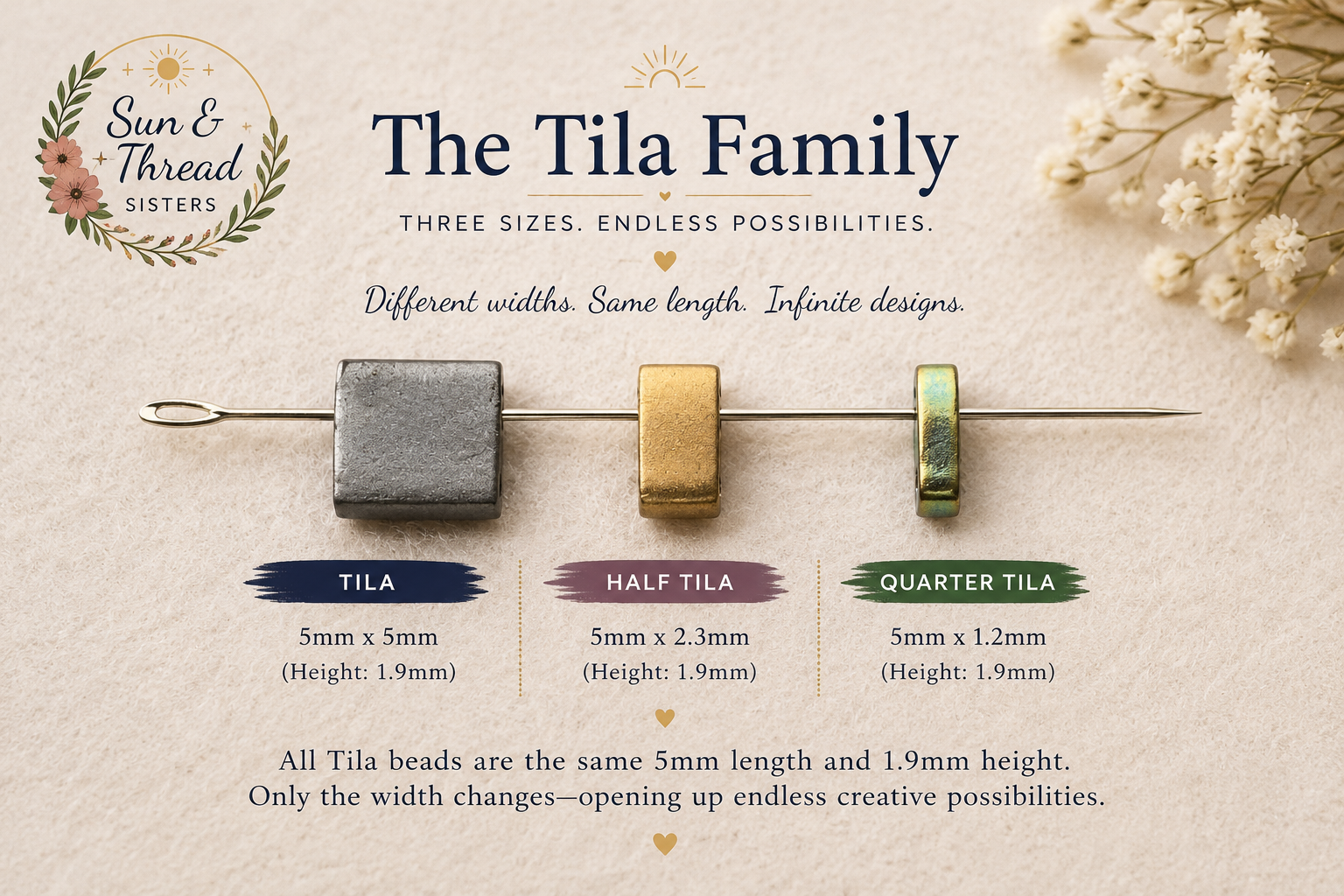
One of my favorite things about the Tila family is how thoughtfully they're designed.
Every bead shares the same:
• 5 mm length
• 1.9 mm thickness
• 0.8 mm hole size
Only the width changes.
BeadDimensionsFull Tila5 × 5 × 1.9 mmHalf Tila5 × 2.3 × 1.9 mmQuarter Tila5 × 1.2 × 1.9 mm
Because they're designed to work together, artists can easily mix all three sizes within the same project to create depth, movement, and beautiful architectural patterns.
Why I Love the Tila Family
One of the things I love most about these beads is that each size has its own personality.
The Full Tila makes a statement.
The Half Tila creates movement.
The Quarter Tila quietly fills the spaces that make a design feel complete.
Together, they remind me that beautiful beadwork isn't about using the biggest bead or the most expensive bead.
It's about understanding how each tiny piece contributes to something much greater.
As bead artists, we spend countless hours choosing colors, finishes, textures, and materials.
The Tila family reminds us that shape can be just as inspiring.
From Our Studio
One of the greatest joys of bead weaving is that every project begins with possibility.
Sometimes that possibility starts with a sketch.
Sometimes it starts with a color palette inspired by nature.
And sometimes...
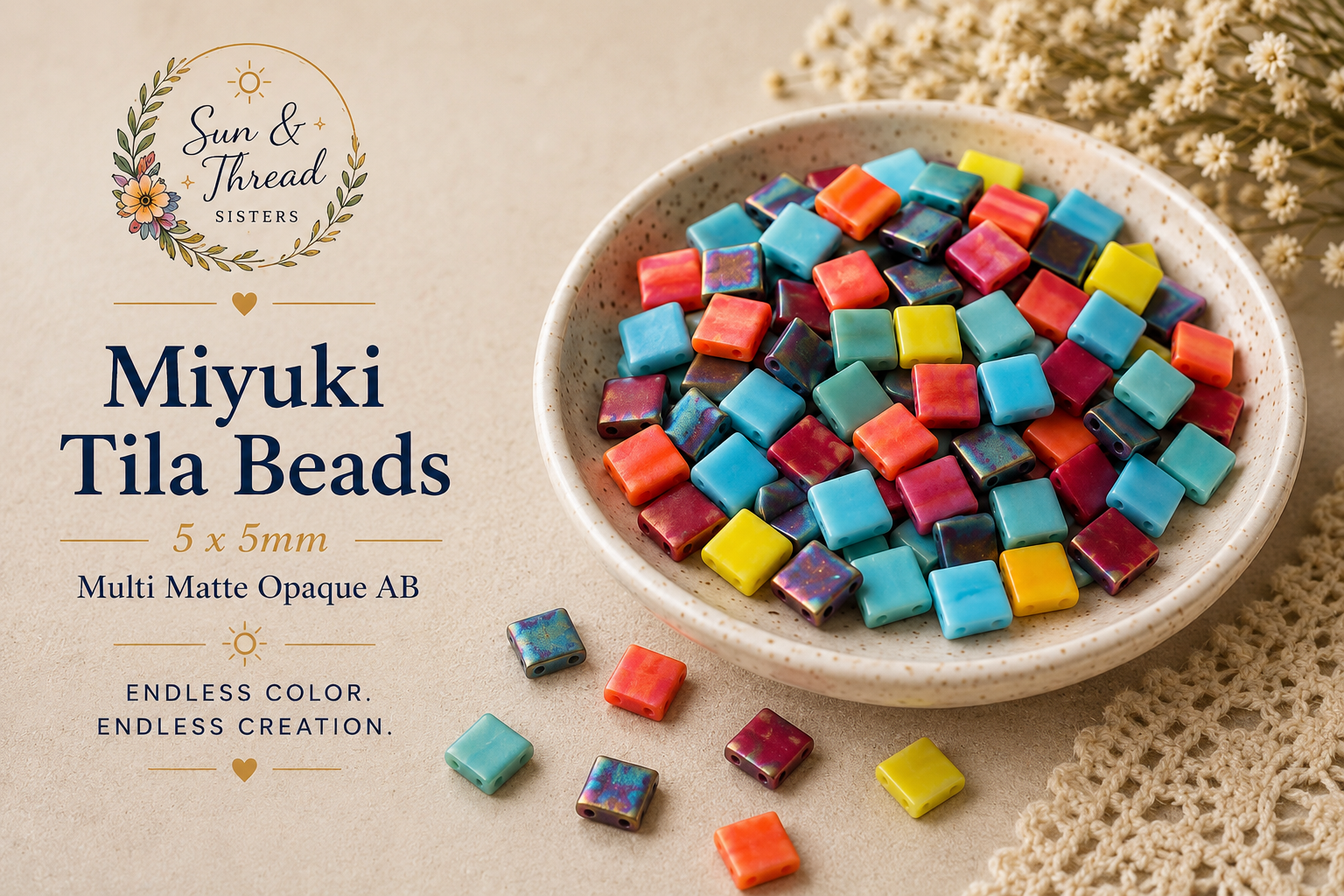
It begins with a handful of beads scattered across a bead mat and a simple question.
"What happens if I try this?"
Those moments of curiosity have led to some of my favorite designs.
They're also the reason I continue learning, experimenting, and teaching.
Every finished bracelet, necklace, or piece of wearable art began as an idea waiting to be explored.
That's one of the reasons I love teaching.
Watching someone discover a new bead for the first time reminds me of why I fell in love with bead weaving in the first place.
☕ Coffee at the Worktable
If you're just beginning your journey with Tila beads, don't feel like you need every color or finish before you start.
Choose a few that make you smile.
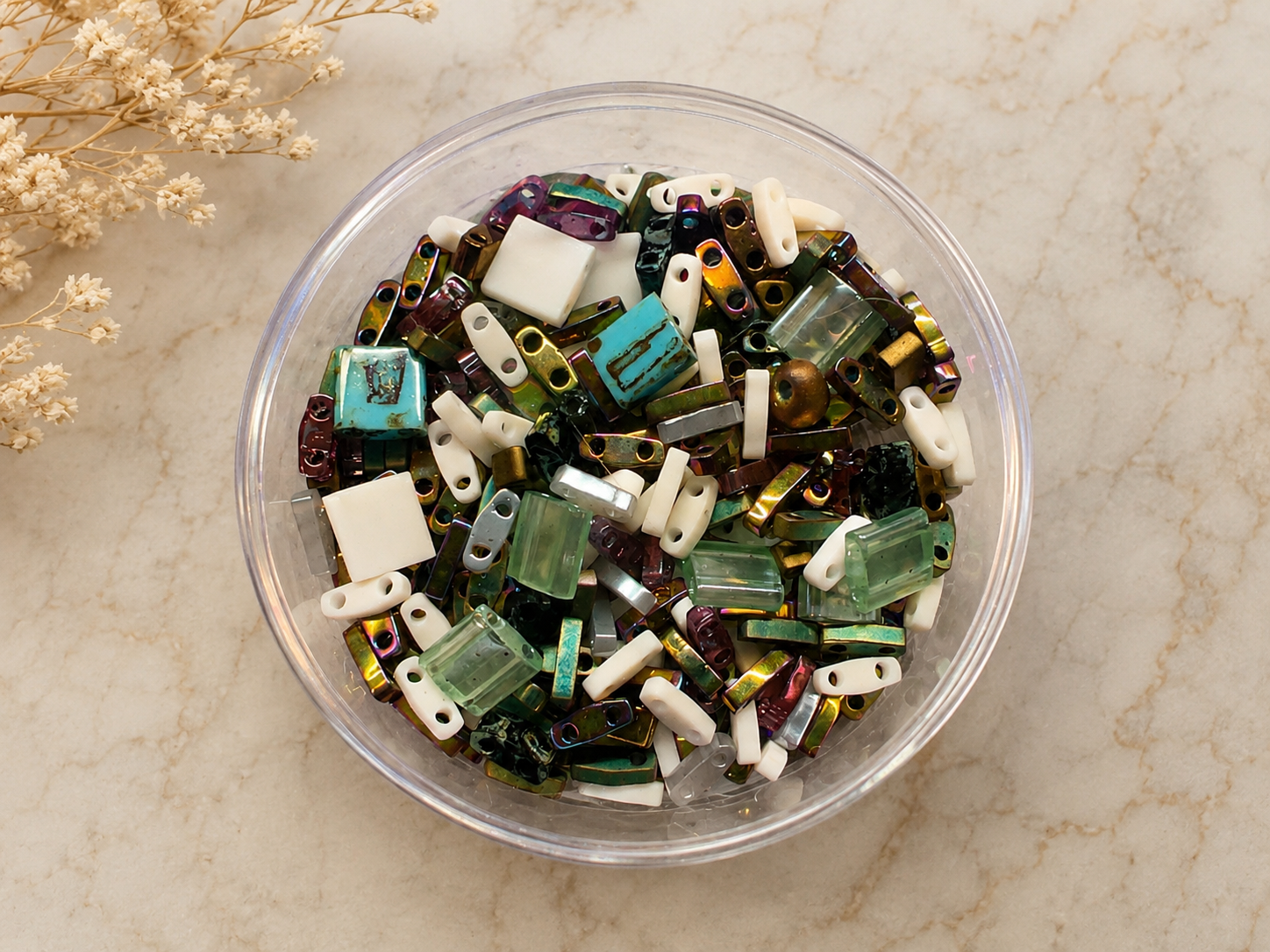
Spread them across your worktable.
Pick them up.
Turn them over in the light.
See how beautifully they fit together.
Some of my favorite designs have started with nothing more than a handful of Half Tilas, a needle, a spool of thread, a cup of coffee, and one simple thought:
"I wonder what would happen if I tried this?"
That's the magic of bead weaving.
The beads may stay the same...
But the possibilities never do.
Until Our Threads Cross Again...
Thank you for spending a little time with us in the studio today.
Whether you've been bead weaving for decades or you've just discovered the Tila family, we hope today's story inspired you to slow down, explore something new, and discover the beauty hidden in even the smallest details.
Our hope for The Sun & Thread Journal is simple—to create a place where artists, collectors, students, and curious makers can gather to learn, be inspired, and celebrate the remarkable world of beadwork together.
May your thread stay untangled, your needle easy to find, and your creativity always lead you somewhere unexpected.
With gratitude,
Kristina & Kimberly
Sun & Thread Sisters
Nature Inspired. Heart Made. Sister Crafted.